
Disclaimer: This guide provides a general operational framework. Always consult and follow the specific manufacturer’s manual, standard operating procedures (SOPs), extruding machineand safety guidelines for your exact machine model before operation.
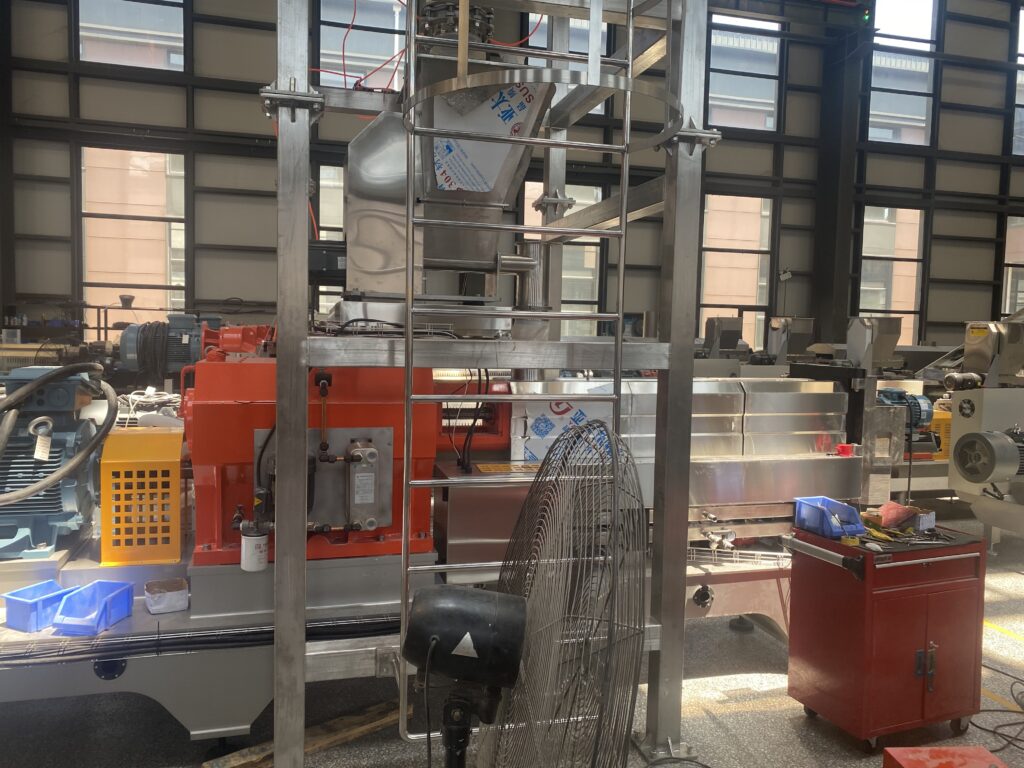
Phase 1: Pre-Startup Preparation & Safety
- Personal Protective Equipment (PPE):
- Mandatory PPE includes safety glasses, heat-resistant gloves, closed-toe shoes, and hearing protection. Avoid loose clothing or jewelry.
- Machine Inspection & Preparation:
- Visual Check: Inspect the entire extruder for any damage, extruding machine loose bolts, or fluid leaks (hydraulic, grease, water).
- Barrel & Die Assembly: Ensure the barrel sections are correctly aligned and securely clamped. Verify the die head and die plate are correctly installed and tightened to specification.
- Screws: Confirm the screw configuration (sequence of conveying, kneading, and mixing elements) is correct for the intended product.
- Cooling/Heating Systems: Check that all barrel cooling water lines and electrical heating bands are connected. Ensure the water flow and temperature control system is functional.
- Feeder: Calibrate the main feeder (and side feeders if used) for the desired feed rate. Ensure the feed hopper is clean and free of obstructions.
- Lubrication: Check the gearbox and thrust bearing oil levels per the maintenance schedule.
- Material Preparation:
- Use raw materials (flour, meal, etc.) with the correct particle size and moisture content as specified in the recipe.
- Pre-blend dry ingredients thoroughly to ensure uniformity.
- Have materials ready and accessible at the feeder.
Phase 2: Startup Sequence
- Auxiliary Systems Start:
- Start the main cooling water circulation system.
- Start the downstream equipment in reverse order: e.g., first the dryer/cooler conveyor, then the pelletizer/cutter, then the dryer/cooler fan.
- Start the main motor of the extruder at the lowest possible speed (e.g., 10-20% of max).
- Heating & Conditioning:
- Set and activate the barrel zone temperature profiles (typically a gradual increase towards the die). Allow time for the barrels to reach set points.
- Start the live steam injection and/or liquid feed to the preconditioner (if equipped). Begin feeding dry material into the preconditioner at a low rate to establish a moisturized, heated mash.
- Initial Feeding & Purge:
- Once barrels are near target temperatures and preconditioner output is stable, extruding machine slowly start feeding material into the main extruder feed port.
- Initially run with the die plate removed or with large, open die holes (a start-up die). This allows the uncooked, cold material to purge through the barrel easily without creating dangerous pressure.
- Observe the material exiting. It will transition from a wet, coarse meal to a hot, plasticized dough.
- Die Engagement & Stabilization:
- Once the material at the die end is fully cooked and hot (typically >130°C), stop the feed and screw.
- Safely install the final production die plate and securing clamps.
- Restart the screws and then the feeder.
- Gradually increase the feed rate and screw speed to their target production setpoints. Make small, incremental adjustments.
- Monitor key parameters: Motor Load (Amps), Specific Mechanical Energy (SME), die pressure, and product temperature.
Phase 3: Steady-State Operation & Monitoring
- Key Parameter Control:
- Die Pressure: The most critical indicator. extruding machine It must remain within a safe, specified range. A sudden increase can signal a blockage; a sudden drop can indicate a loss of feed.
- Motor Load / SME: Indicates the mechanical work input. Adjust feed rate, screw speed, or moisture to maintain target SME, which directly affects product texture.
- Temperatures: Monitor each barrel zone and product melt temperature. Adjust heating/cooling or steam injection to maintain the profile.
- Product Quality: Continuously check the extrudate for:
- Shape & Expansion: Uniformity, size, degree of puffing.
- Texture: Correct hardness, crispness.
- Color & Moisture.
- Making Adjustments:
- To Increase Expansion/Reduce Density: Increase temperature, decrease moisture, increase screw speed, or use a more restrictive die.
- To Increase Density/Reduce Expansion: Increase moisture, decrease temperature, or decrease screw speed.
- Always make one change at a time and allow the process to stabilize (2-5 minutes) before assessing the effect.
Phase 4: Shutdown Procedure

- Orderly Feed Ramp-Down:
- Gradually reduce the feed rate from the main and side feeders.
- Begin to reduce the screw speed proportionally to prevent the barrel from emptying too quickly.
- Clearing the Barrel:
- Once feeders are empty, introduce a “purging material” (e.g., high-fiber bran, oilseed meal, or a proprietary purge mix) to push out the remaining product formula.
- Continue until only the purge material is exiting the die. This prevents hardened product from clogging the screws or die.
- System Shutdown:
- Stop all feeders.
- Turn off steam and liquid injection to the preconditioner and barrel.
- Slowly reduce screw speed to minimum and then stop the main motor.
- Turn off barrel heaters.
- Keep the cooling water running and allow the screws to rotate at a very low speed intermittently until barrel temperatures fall below 80°C to prevent heat damage. Then stop cooling and auxiliary systems.
- Disassembly & Cleaning:
- Once the machine is fully cooled, follow lock-out/tag-out (LOTO) procedures.
- Carefully disassemble the die head and screws.
- Clean all components thoroughly using appropriate tools (brass scrapers, non-abrasive pads). Never use steel tools on barrel internals.
Core Principle: Successful extrusion operation relies on steady-state control. The goal is to reach and maintain a stable equilibrium where all input parameters (feed, moisture, heat, mechanical energy) are balanced to produce a consistent output. Patience during startup and vigilant monitoring are the keys to efficiency, safety, and product quality.
 English
  Russian
  Spanish
  Italian
  Arabic
  Portuguese
  German
  French
  Japanese
  Moroccan Arabic
  Persian
  Belarusian