The twin-screw extruder stands as one of the most versatile and transformative machines in modern manufacturing. From the snacks on your kitchen shelf to the biodegradable plastics in development labs, this remarkable piece of engineering performs functions that would otherwise require entire factory floors of separate equipment. Understanding what a twin-screw extruder does—and how it does it—reveals why it has become indispensable across dozens of industries.
What Is a Twin-Screw Extruder?
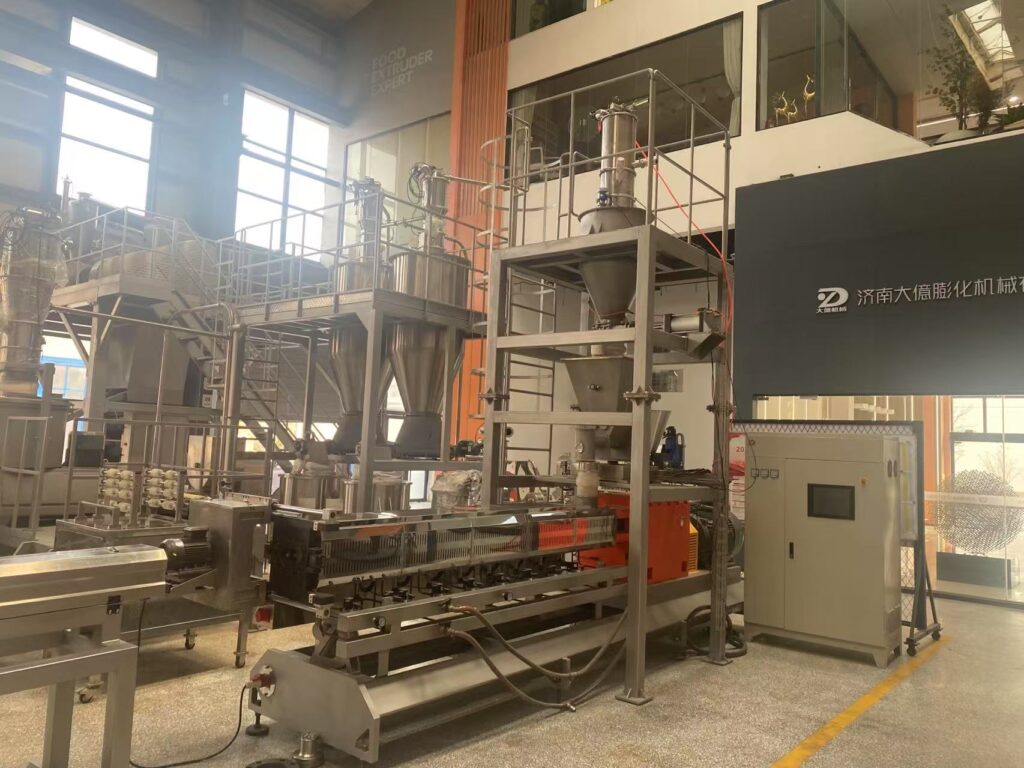
At its simplest, a twin-screw extruder is a machine that processes materials by forcing them through a heated barrel using two intermeshing rotating screws. But this description belies the complexity of what actually occurs inside that barrel. The twin-screw design offers something its single-screw cousin cannot: precise control over mixing, transport, and energy input, regardless of the material’s properties .
The screws themselves are not simple augers. They are assembled from modular elements—conveying sections, kneading blocks, and mixing lobes—that can be arranged like beads on a string to create exactly the right mechanical environment for a specific material. This modularity is the secret to the machine’s extraordinary flexibility.
The Core Functions
1. Conveying: Moving Material Forward
The most basic function of any extruder is to move material from the feed inlet to the die. In a twin-screw extruder, this conveying action is positive and predictable. Unlike single-screw machines, where material movement depends on friction against the barrel wall, twin-screws use mechanical displacement. The intermeshing screws create a sealed C-shaped chamber that physically pushes the material forward with each rotation .
This positive displacement mechanism means twin-screw extruders can handle sticky, slippery, or otherwise difficult materials that would stall a single-screw machine. It also means they can generate pressure efficiently, pushing material through restrictive dies to create shaped products.
2. Mixing: The Art of Homogenization
Mixing is arguably where the twin-screw extruder truly shines. The machine performs two distinct types of mixing:
Distributive Mixing spreads ingredients evenly throughout the matrix without breaking them down. This is essential for incorporating minor ingredients like colors, flavors, or stabilizers. Specialized mixing elements with large flow channels accomplish this by repeatedly dividing and reorienting the material stream .
Dispersive Mixing actually breaks apart particles. When you need to reduce agglomerates or incorporate immiscible liquids (like oil into water-based dough), high-shear kneading blocks generate intense localized stress that physically tears materials apart. The gap between the screw and the barrel wall can be as small as a fraction of a millimeter, creating shear rates that would be impossible in any other type of mixer .
3. Cooking: Thermal and Mechanical Energy
The twin-screw extruder is, in essence, a continuous chemical reactor. It applies energy to materials in two forms:
Thermal energy comes from the electrically heated barrel jackets. These bring the material up to temperature, initiating chemical reactions like starch gelatinization or protein denaturation.
Mechanical energy comes from the rotation of the screws. As the screws turn, they impart energy to the material through friction and viscous dissipation. This mechanical energy input—measured as Specific Mechanical Energy or SME—often contributes more to cooking than the barrel heaters do .
For snack foods like Cheetos, this combination of thermal and mechanical energy creates the superheated, pressurized melt that explodes into a light, airy puff when it exits the die .
4. Venting: Removing Unwanted Components
Many extrusion processes require the removal of volatile compounds. Twin-screw extruders accommodate this through vent ports—openings in the barrel where vacuum can be applied to draw off moisture, air, or unwanted reaction byproducts .
In de-volatilization applications, the screw design includes “relaxation zones” where the material is only partially filled, allowing volatile gases to escape from the surface. This is critical for producing high-quality plastics, rubber compounds, and even some food products where bubbles or off-flavors would be unacceptable .
5. Reaction: Chemical Transformation
Beyond simple mixing and cooking, twin-screw extruders can host actual chemical reactions. The continuous, self-wiping nature of the machine makes it an ideal chemical reactor for processes requiring precise temperature control and short residence times .
Reactive extrusion is used to modify starches and proteins in food applications, to polymerize monomers in plastic production, and even to compatibilize blends of incompatible materials. The extruder becomes a factory-in-a-pipe, transforming raw ingredients into finished chemical products in seconds rather than hours .
6. Shaping: Creating Final Form
Ultimately, everything that happens inside the extruder leads to this moment: the material exits through a die and takes its final shape. The die is essentially a specialized nozzle—a hole or pattern of holes cut into a thick steel plate.
The shape of the die determines the cross-section of the product. Round holes produce rods or pellets; slots produce sheets or ribbons; complex profiles produce the specific shapes of pasta, pet food kibble, or snack pellets .
For expanded products like breakfast cereals or cheese puffs, the die is also where the magic happens. As the superheated, pressurized melt exits into atmospheric pressure, the moisture flashes to steam, causing the material to expand instantly. This expansion ratio—sometimes reaching 10:1 or greater—is controlled by the temperature, pressure, and moisture content established inside the barrel .
Types of Twin-Screw Extruders
Not all twin-screw extruders are created equal. They fall into two main categories based on screw rotation:
Co-rotating extruders have screws that turn in the same direction. This configuration provides the highest mixing intensity and is preferred for compounding, food processing, and reactive extrusion. The screws wipe each other clean, preventing material from stagnating .
Counter-rotating extruders have screws that turn opposite directions. This creates a more positive pumping action with lower shear, making it ideal for profile extrusion (like PVC window frames) and other applications where gentle handling is critical .
Applications Across Industries
The versatility of twin-screw extruders has made them indispensable across manufacturing:
- Food and Snacks: Producing breakfast cereals, textured vegetable protein, pasta, pet food, and puffed snacks.
- Plastics: Compounding additives into polymer resins, recycling post-consumer plastic, and producing finished profiles.
- Pharmaceuticals: Creating solid dispersions for improved drug bioavailability.
- Rubber: Mixing additives into rubber compounds before vulcanization.
- Biomaterials: Processing biopolymers and creating biodegradable packaging.
Заключение
The twin-screw extruder is far more than a simple pump or mixer. It is a conveying system, a high-shear mixer, a thermal reactor, a devolatilization chamber, and a forming press—all contained within a single integrated machine. Its modular design allows processors to tailor the internal geometry to their exact needs, while its continuous operation enables production rates that batch processing could never match.
From the Cheetos dust on your fingers to the plastic bumper on your car, chances are good that a twin-screw extruder played a role in bringing that product to life. It is, without exaggeration, one of the most important manufacturing technologies you’ve never thought about.
 Russian
  English
  Spanish
  Italian
  Arabic
  Portuguese
  German
  French
  Japanese
  Moroccan Arabic
  Persian
  Belarusian