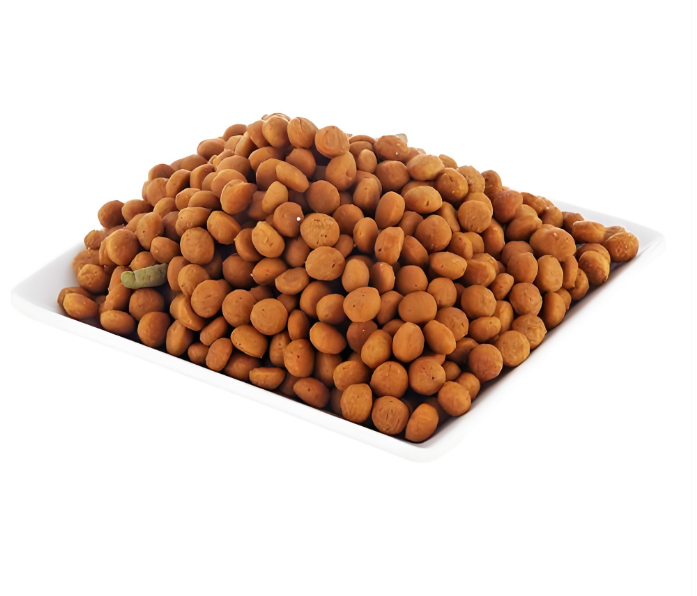
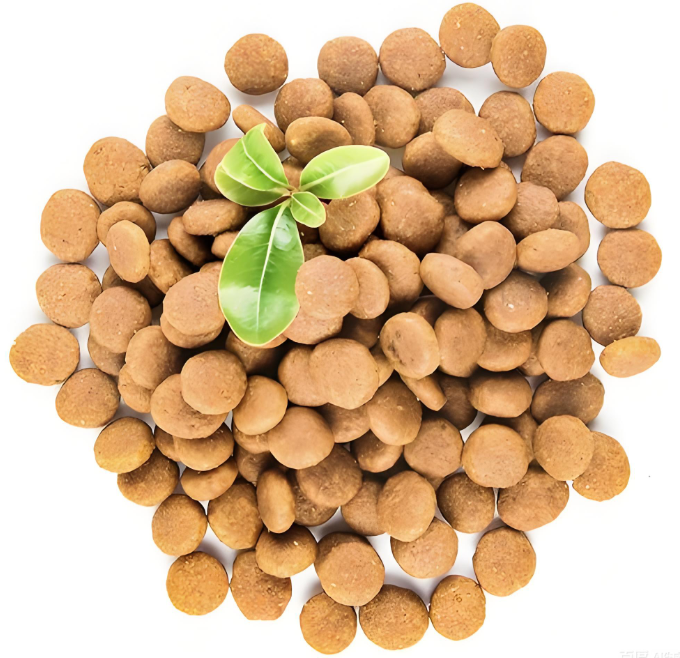
When manufacturing dry dog food (kibble), extrusion often gets the spotlight, but drying is the true make-or-break stage. Improper drying leads to mold growth, nutrient loss, poor texture, and short shelf life. Mastering drying ensures a shelf-stable, crunchy, and safe product that dogs love and owners trust.
This article outlines the key principles, equipment, and control points for effective kibble drying.
1. Why Drying Is Critical
Freshly extruded kibble contains 20–25% moisture. If packaged as is, it will spoil within days due to:
Microbial growth (mold, bacteria)
Enzymatic degradation (rancidity, off-flavors)
Soft, chewy texture (unappealing to dogs and owners)
The goal of drying is to reduce moisture to 6–10% , achieving:
Water activity (aw) below 0.6 – Prevents microbial growth
Crunchy texture – Mechanical breakdown aids dental health
Stable shelf life – 12–18 months without preservatives
Key metric: Every 1% excess moisture above 10% doubles the risk of mold within 3 months.
2. The Science of Kibble Drying
Drying is a heat and mass transfer process:
Heat evaporates water from the kibble surface.
Mass transfer moves internal moisture to the surface.
Two phases occur:
Phase
What Happens
Rate
Constant rate
Surface water evaporates freely
Fast
Falling rate
Internal moisture diffuses outward
Slow (controls total time)
The falling rate phase determines drying time and uniformity. If rushed, the outer layer hardens (case hardening), trapping moisture inside.
Critical principle: Slow drying in the falling rate phase prevents case hardening and ensures even moisture distribution.
3. Key Drying Equipment for Dog Food
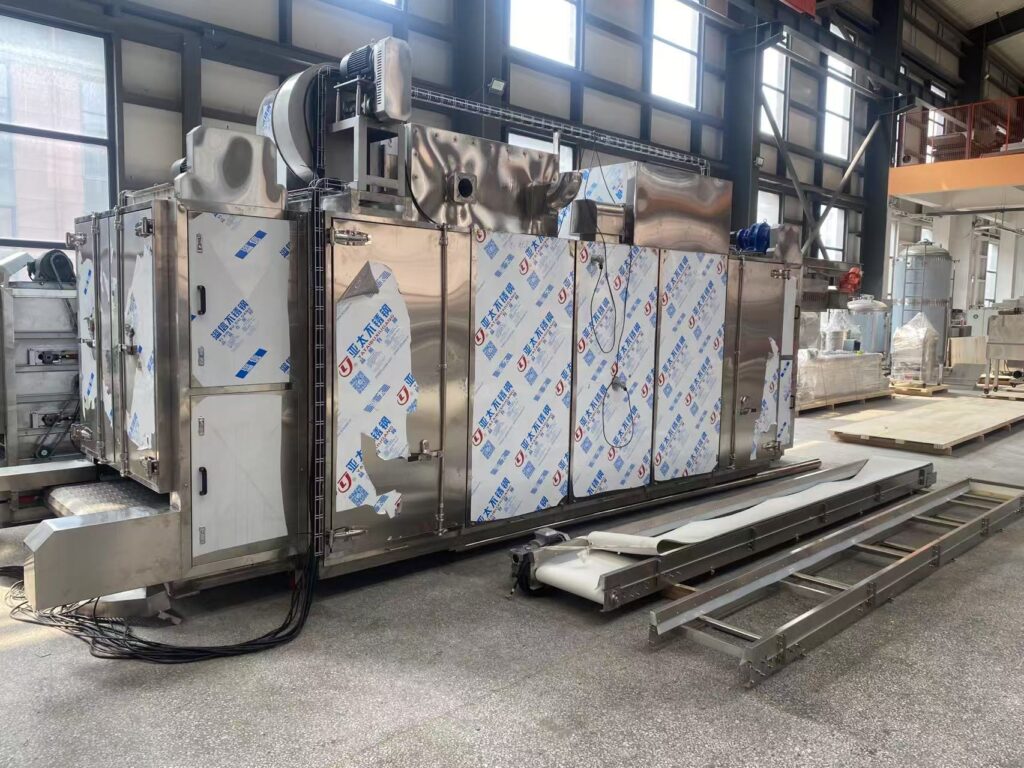
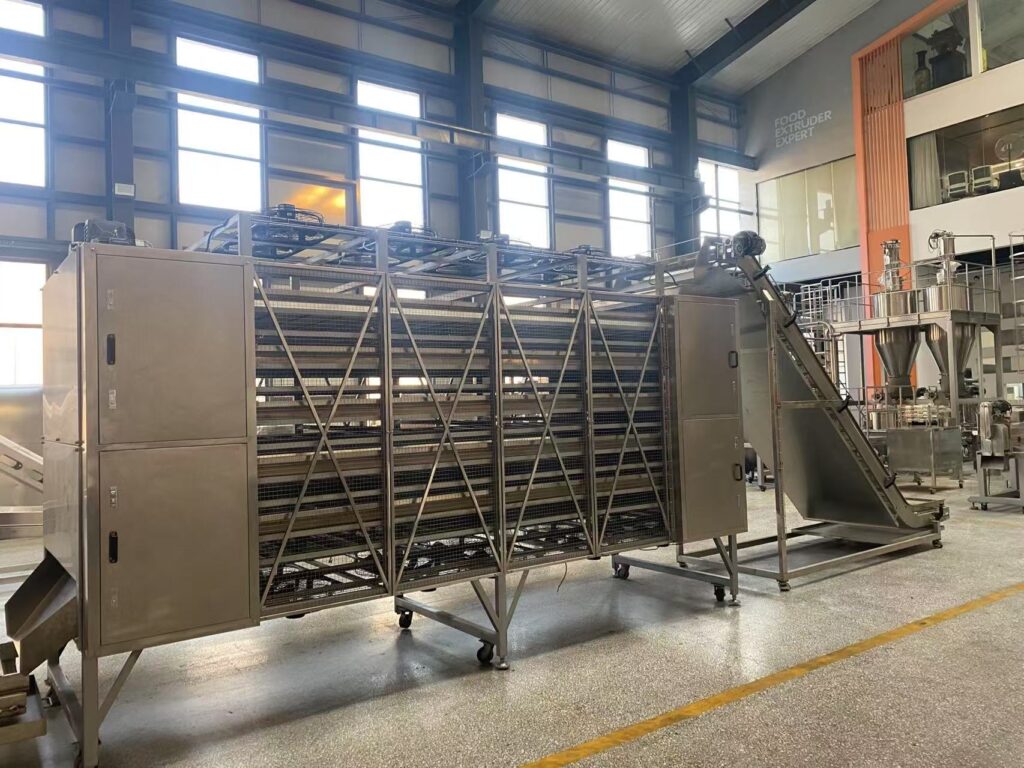
Most industrial dog food production uses multi-stage belt dryers.
Multi-Stage Belt Dryer (Most Common)
How it works: Kibble moves on perforated belts through zones with varying temperature, humidity, and airflow.
Typical zones:
Zone 1 (120–150°C) – Rapid surface drying
Zone 2 (90–120°C) – Falling rate drying
Zone 3 (60–80°C) – Final equilibration
Retention time: 20–40 minutes
Capacity: 1–10 tons/hour
Alternative Dryers
Тип
Best For
Pros
Cons
Rotary dryer
Very high capacity (10+ t/h)
Continuous, robust
Higher breakage
Fluid bed dryer
Small, delicate kibble
Gentle, uniform
Higher energy use
Vacuum dryer
Premium,低温 lines
Preserves nutrients
Batch process, expensive
Industry standard: Multi-stage belt dryer offers the best balance of capacity, quality, and energy efficiency.
4. Critical Drying Parameters (Control Points)
To produce consistent, high-quality kibble, operators must monitor and adjust these parameters in real time.
4.1 Inlet Moisture (Pre-Dryer)
Target: 22–24% after extrusion
Why: Too high extends drying time; too low indicates poor extrusion control.
4.2 Temperature Profile
Zone 1: 120–150°C – High but short to avoid surface scorching.
Zone 2: 90–120°C – Moderate for internal moisture removal.
Zone 3: 60–80°C – Gentle for final equilibration.
Exit kibble temperature: Should be <40°C before packaging.
4.3 Airflow & Humidity
Air velocity: 1.5–3 m/s through the bed
Relative humidity: Decreasing from 40% (Zone 1) to 15% (Zone 3)
Adjust based on: Kibble size (larger needs more time), initial moisture, and target final moisture.
4.5 Bed Depth
Target: 5–15 cm on the belt
Too shallow: Low throughput, wasted energy
Too deep: Uneven drying, wet center, case hardening
5. Common Drying Defects and Solutions
Defect
Cause
Solution
Case hardening (dry shell, wet core)
Zone 1 temperature too high; too fast initial drying
Reduce Zone 1 temp; increase humidity in early zones
Surface cracking
Too rapid moisture removal
Lower airflow; reduce temperature ramp rate
Scorched / burnt kibble
Zone 1 temperature too high or belt jam
Reduce temp; ensure even bed distribution
Mold after packaging
Final moisture >10% or uneven drying
Increase retention time; check zone 3 performance
Soft / chewy texture
Insufficient drying overall
Extend retention time; raise zone 2 temperature
High breakage / fines
Over-drying or mechanical impact
Reduce temperature; slow belt speed; add gentle conveyors
6. Post-Drying Handling
Drying doesn’t end at the dryer exit. Two more steps are critical:
6.1 Cooling
Equipment: Counterflow cooler (ambient or chilled air)
Target exit temperature: <40°C (ideally 30–35°C)
Why: Warm kibble will condense moisture inside the bag, leading to mold.
6.2 Moisture Equilibration (Tempering)
Процесс: Hold dried kibble in a silo for 1–4 hours before coating/packaging.
Why: Allows residual internal moisture to redistribute evenly throughout each piece.
Result: Uniform final moisture (±0.5% variation).
7. Quality Control Tests for Dried Kibble
Every batch should be tested for:
Test
Method
Specification
Moisture content
Oven drying (135°C for 2h) or NIR
6–10% (premium: 7–9%)
Water activity (aw)
aw meter
<0.65 (ideal <0.60)
Hardness / Crunch
Texture analyzer
8–15 kg force (varies by size)
Color
Visual or colorimeter
Consistent with standard
Fines (% broken)
Sieve analysis
<2% passing through 2mm screen
Frequency: At least every 30 minutes during production.
8. Energy Efficiency Considerations
Drying consumes 50–70% of total energy in a dog food plant. Efficiency improvements include:
Heat recovery: Recapture exhaust heat to preheat incoming air.
Multi-stage drying: Remove 70% of moisture in the first two zones (where efficiency is highest).
Proper insulation: Reduce heat loss from dryer walls.
Automatic moisture control: Use inline NIR sensors to adjust temperature and retention time dynamically, avoiding over-drying.
9. Summary: The 5 Keys to Successful Dog Food Drying
Key
Action
1. Control inlet moisture
Keep 22–24% post-extrusion
2. Use a temperature profile
Start high (Zone 1), finish low (Zone 3)
3. Avoid case hardening
Don’t rush the falling rate phase
4. Cool before packaging
Target <40°C exit temperature
5. Test every batch
Moisture, aw, hardness, fines
Заключение
Drying is not simply “removing water” — it is a carefully controlled thermal process that defines the final quality of dry dog food. A well-dried kibble is crunchy, safe, and stable. A poorly dried one is prone to mold, rancidity, and rejection by both dogs and owners.
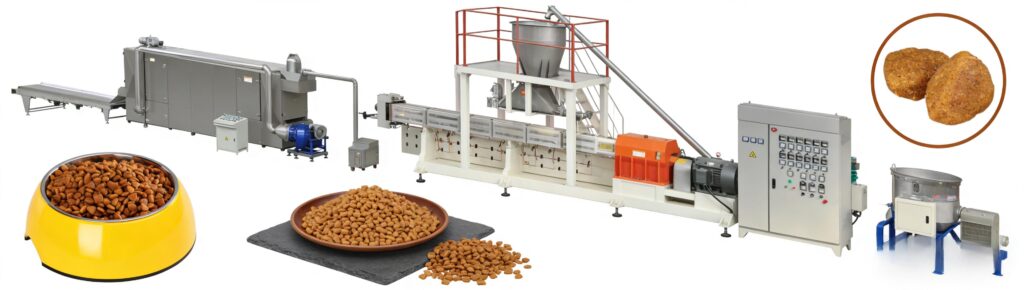
By mastering the key parameters — temperature profile, airflow, retention time, and post-drying handling — manufacturers can produce dog food that stands out for its consistent texture, extended shelf life, and canine appeal. If you are interested in the dog food machinery, you can contact me , i will give you good advice and solutions .
1.Will you help us with the installation ?
Yes , We will send engineers to install and debug the equipment, and assist in training your staff.
2.Are you a factory or trading company?
We are a factory.
3.What certificate do you have?
We have ISO and CE certificate.
4.How long is the warranty period?
All of our machines have one year warranty.
5.What’s the main market of your company?
Our customers all over the world.
6.How much production capacity of your company one year?

 Russian
  English
  Spanish
  Italian
  Arabic
  Portuguese
  German
  French
  Japanese
  Moroccan Arabic
  Persian
  Belarusian