
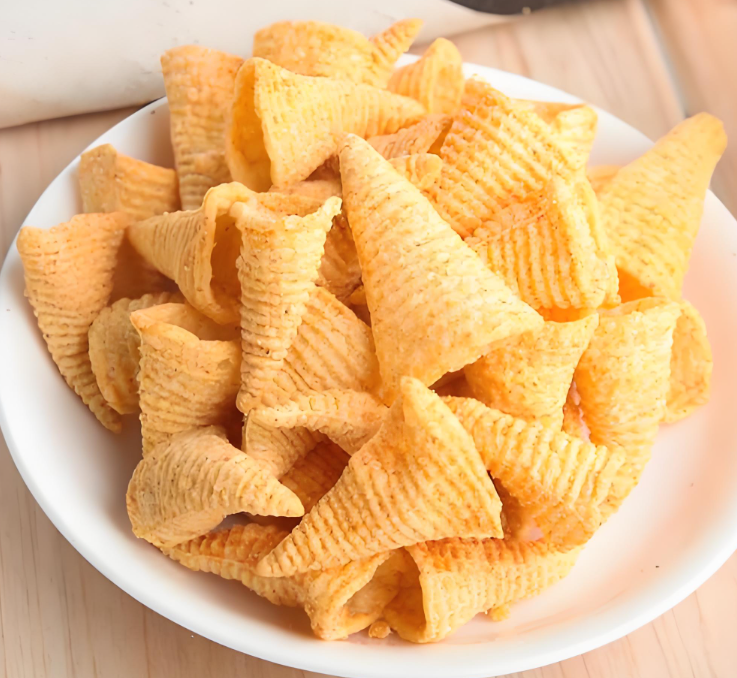
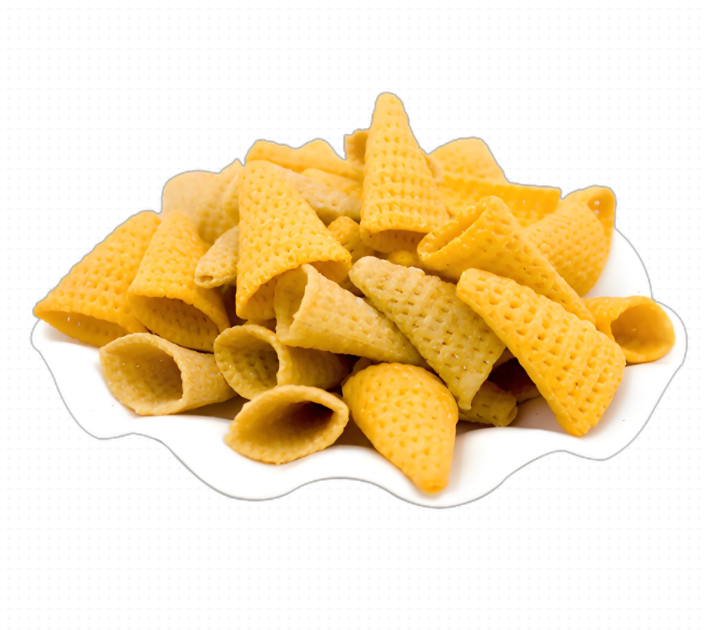
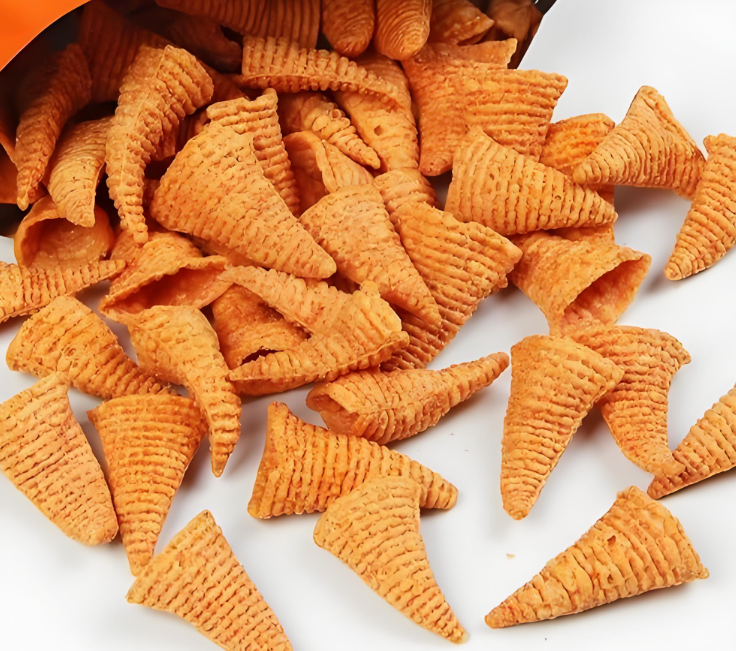
The distinctive conical shape of a Bugles snack is instantly recognizable. Meant to be worn on fingertips before being eaten, this iconic corn snack seems simple enough. bugles making machine But beneath its playful exterior lies a manufacturing process of surprising sophistication—a journey of high-pressure extrusion, precise temperature control, and molecular transformation that turns simple cornmeal into a structured, crispy cone. An “exposé” of the Bugles processing technique reveals a world of food engineering far removed from the simple snack it appears to be.
The Blueprint: It Starts with a Powder
The journey of a Bugles begins not as a dough, but as a dry blend of powdered ingredients. The primary raw materials are starches—typically corn starch, rice starch, and potato starch—which provide the structure and texture . These are combined with water in a mixer to create a hydrated mixture, targeting a moisture content of around 28% to 35% . This initial step, known as, is critical for allowing the starches to begin the process of water absorption (hydration), setting the stage for the transformations to come .
The Crucible: High-Pressure Extrusion
This is where the magic—and the industrial power—truly begins. The hydrated mixture is fed into a massive machine called an extruder. Think of it as a high-pressure, high-temperature reactor that cooks and shapes the material in one continuous process.
- Preconditioning and Cooking: The material first enters a preconditioning zone where it is subjected to heat (around 100–120°C) and moderate pressure (2–3 atmospheres) . This stage, often called , uses a rotating screw to mechanically work the mixture while heating it. The goal is to achieve 90–100% gelatinization of the starches . In simple terms, the starch granules are forced to absorb water and swell, bursting their crystalline structure and turning the mixture into a molten, plastic-like, and fully cooked dough .
- Shaping the Sheet: This hot, plastic dough is then gently pushed by a second, low-shear screw into a die—a specially shaped opening at the end of the extruder. This die is not forming the final cone shape. Instead, it extrudes the dough into a wide, flat sheet approximately 200mm wide and a mere 0.8 to 1mm thick . At this stage, the sheet is semi-translucent and flexible . The precision of this sheet’s thickness is paramount, as it directly determines the final product’s texture and the success of the subsequent forming steps .
The Choreography of Creation: Forming the Cone
The flat sheet now embarks on a carefully choreographed journey to become a three-dimensional cone. This is the most distinctive and ingenious part of the Bugles process.
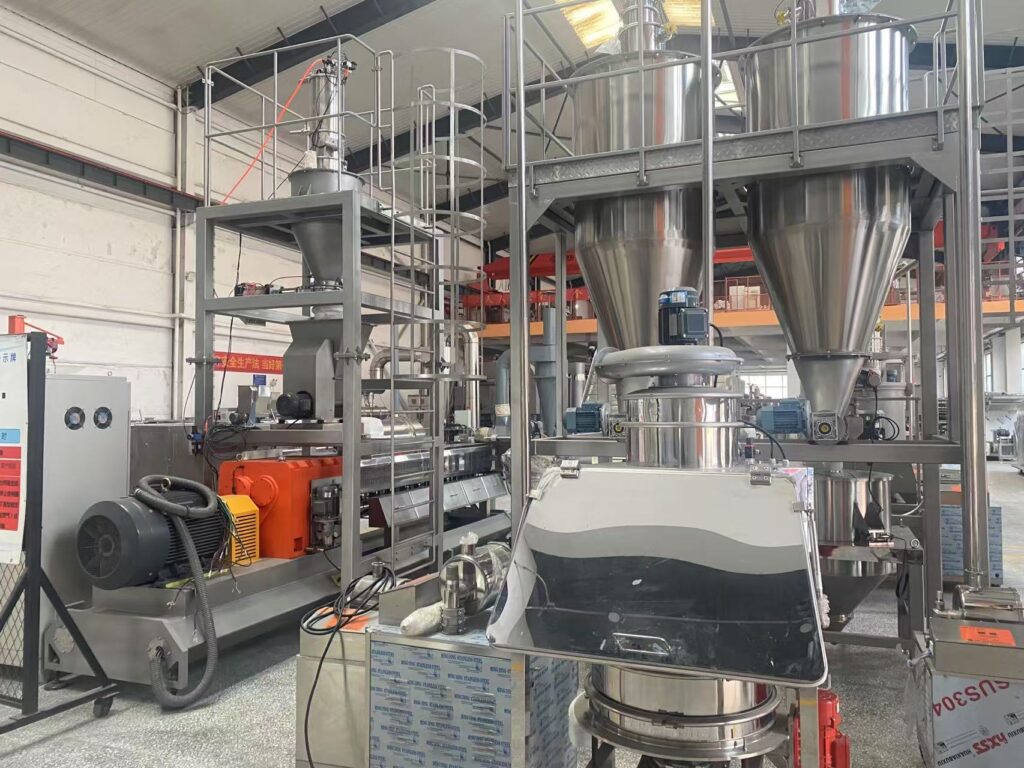
- Cooling Down: The hot, pliable sheet must first be cooled to stabilize it. bugles making machine It travels along an 8 to 12-meter cooling line, which firms it up enough to be handled without sticking to the machinery .
- The Art of Lamination : The cooled sheet enters a , or laminating station, which performs three tasks in perfect sequence .
- Embossing: First, the sheet passes through a set of embossing rollers. These rollers press a fine mesh-like pattern onto the surface. This isn’t just for decoration; it provides structure and helps with the next step.
- Folding: The critical moment arrives. The single embossed sheet is split into two strips, which are then guided and folded so that their edges overlap as they pass through a复合辊 (combining roller). This overlapping and folding action is what creates the hollow, conical shape of the Bugles.
- Recycling: Excess trimmings from the edges are automatically cut away and sent back via a conveyor to the extruder to be reused, ensuring zero waste in this continuous process .
The Final Transformation: Frying into a Snack
The raw, cone-shaped pellets that emerge from the laminator are fragile and have a moisture content of 20% to 30% . They cannot be fried immediately, or they would fall apart. They first enter a dryer, where warm air (around 60°C) gently reduces their moisture to a more stable 12% over a longer period . This step solidifies their structure and prevents them from sticking together.
The moment of truth is the fryer. The dried pellets are submerged in hot oil at temperatures exceeding 300°F (approx. 150°C) . The intense heat causes the residual water inside the pellet to flash into steam. This steam expands rapidly, puffing the product from the inside out and creating the light, crispy, porous texture we associate with Bugles. In fact, the坯料 (pellets) will expand 2 to 3 times in size during frying . The final moisture content drops to just 2% to 3% .
After a quick spin in a centrifuge to remove excess oil, the now-crispy Bugles are tumbled in a large drum where they are sprayed or dusted with a carefully formulated blend of flavorings, including flavor enhancers, maltodextrin, and spices like black pepper powder . From there, they are packaged and ready to find their way onto a fingertip near you.
The Not-So-Secret Ingredients: A Note on Health
While the engineering behind Bugles is impressive, the “exposé” would not be complete without acknowledging the nutritional reality. As a puffed and fried corn snack, Bugles fall into the category of foods that are often high in fat, calories, and sodium due to the frying process and added seasonings . In fact, the Chinese Children and Adolescent Snack Consumption Guide issued in 2014 classifies snacks like Bugles as “restricted consumption,” recommending they be eaten no more than once a week .
Furthermore, regulatory attention has been paid to the use of aluminum-containing additives in puffed foods. In 2013, China’s Ministry of Health proposed removing the allowance for such additives in to reduce aluminum intake, particularly for children .
In conclusion, the Bugles snack is a marvel of modern food processing—a testament to how heat, pressure, and mechanical precision can transform simple agricultural starches into a structurally complex and enjoyable product. It is a story of industrial ingenuity, even if the final product is best enjoyed as an occasional treat.
 Russian
  English
  Spanish
  Italian
  Arabic
  Portuguese
  German
  French
  Japanese
  Moroccan Arabic
  Persian
  Belarusian