
A food puffing machine—often referred to as a puff extruder или extrusion puffing machine—is industrial equipment designed to produce light, crispy, expanded snack products by combining mixing, cooking, pressurizing, and shaping in a continuous process. It is widely used in the manufacture of puffed snacks, breakfast cereals, pet foods, and various grain-based convenience products.
How It Works
The puffing process is based on a simple physical principle: high temperature and pressure inside the barrel, followed by rapid pressure release at the die outlet.
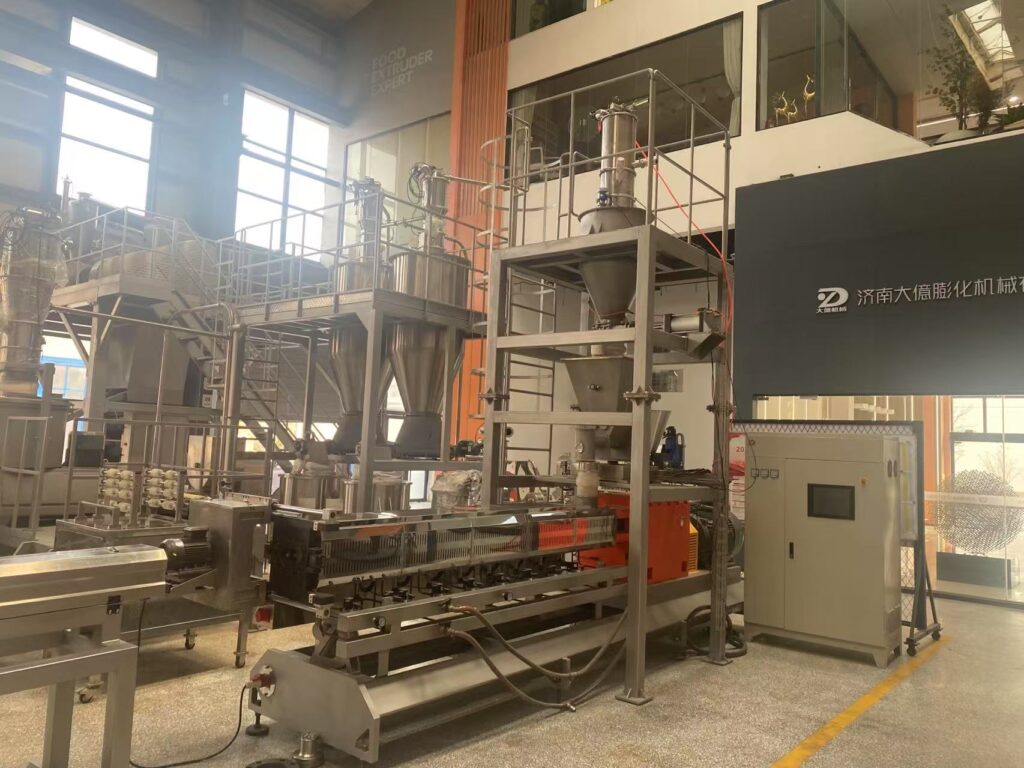
- Feeding: Raw materials such as corn, rice, wheat, potato starch, or mixed flours are fed into the machine through a hopper.
- Cooking and Plasticizing: Inside the barrel, rotating screws convey the material forward while generating frictional heat. Many machines also use electric heaters or steam assistance to control temperature precisely.
- Pressurization: As the material moves forward, it becomes a cooked, viscoelastic dough under high pressure.
- Shaping and Puffing: When the dough exits through the die, the pressure drops instantly. Moisture flashes into steam, expanding the product to form a porous, crispy structure.
- Cutting and Discharging: A rotary cutter can shape the product into desired lengths before it is conveyed to drying, flavoring, or packaging systems.
Key Components
A typical puffing machine includes:
- Feeding system: Ensures stable and continuous input of raw materials.
- Extrusion barrel and screw(s): The core section where cooking, mixing, and compression occur.
- Heating and temperature control: Maintains consistent product quality.
- Die and mold set: Determines product shape (rings, balls, tubes, stars, etc.).
- Cutting system: Controls size and appearance.
- Drive motor and gearbox: Provide reliable torque for stable extrusion.
Types of Puffing Machines
- Single-screw extruders: Cost-effective and easy to operate; suitable for many common puffed snacks.
- Twin-screw extruders: Better mixing and process control; ideal for complex formulas, high-protein products, or specialty textures.
Applications
Food puffing machines are highly versatile and can produce:
- Puffed snack pellets and ready-to-eat snacks (corn puffs, rice sticks, rings)
- Breakfast cereals and granola-like expanded shapes
- Nutritional snacks fortified with protein, vitamins, or fiber
- Pet food and aquatic feed (depending on configuration)
- Innovative plant-based products requiring controlled texture and expansion
Advantages
- High efficiency: Continuous production with stable output.
- Consistent quality: Controlled temperature, moisture, and pressure improve uniformity.
- Flexible recipes: Supports various grains, starches, and functional ingredients.
- Multiple shapes: Quick die changes enable diverse product designs.
- Scalable operation: Suitable for small factories to large-scale production lines.
Заключение
A food puffing machine is a crucial piece of modern snack and cereal manufacturing technology. By using controlled extrusion and rapid expansion, it transforms simple grain or starch blends into appealing, crunchy products with a wide range of shapes and flavors. With the right configuration and process settings, manufacturers can achieve efficient production, consistent texture, and strong market adaptability.
 Russian
  English
  Spanish
  Italian
  Arabic
  Portuguese
  German
  French
  Japanese
  Moroccan Arabic
  Persian
  Belarusian