
Pet food—whether kibble, canned, or freeze-dried—is a staple in millions of households. But what actually goes into making it? Behind the glossy bags and appealing marketing lies a sophisticated manufacturing process that combines food science, nutritional engineering, and industrial precision. This article pulls back the curtain on how pet food is made, from raw materials to the finished product sitting in your pantry.
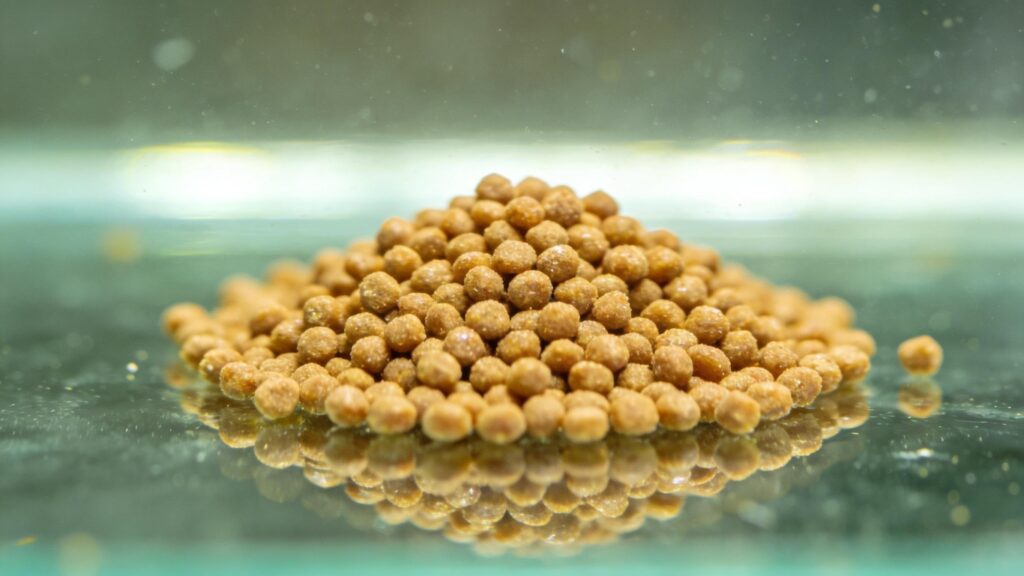
1. The Raw Materials: More Than Just “Meat and Grains”
Pet food formulations are built on a foundation of ingredients that must meet nutritional requirements set by organizations like AAFCO (Association of American Feed Control Officials). The main categories include:
| Ingredient Category | Examples | Purpose |
|---|---|---|
| Protein sources | Chicken meal, lamb meal, fish meal, fresh meats, poultry by-product meal, plant proteins (soy, corn gluten) | Muscle maintenance, tissue repair, energy |
| Carbohydrates | Corn, rice, wheat, barley, potatoes, peas | Energy, structure, fiber |
| Fats & oils | Chicken fat, fish oil, vegetable oils | Energy density, omega fatty acids, palatability |
| Vitamins & minerals | Vitamin premixes, chelated minerals, calcium, phosphorus | Bone health, immune function, metabolic processes |
| Functional additives | Probiotics, prebiotics, glucosamine, chondroitin, antioxidants | Digestive health, joint support, shelf life |
Ingredient Terminology: What “Meal” Means
You’ll often see “chicken meal” or “lamb meal” on ingredient lists. Meat meal is rendered meat that has had most of its moisture removed, leaving a concentrated protein powder. It typically contains 4–5 times more protein by weight than fresh meat, making it a highly efficient ingredient.
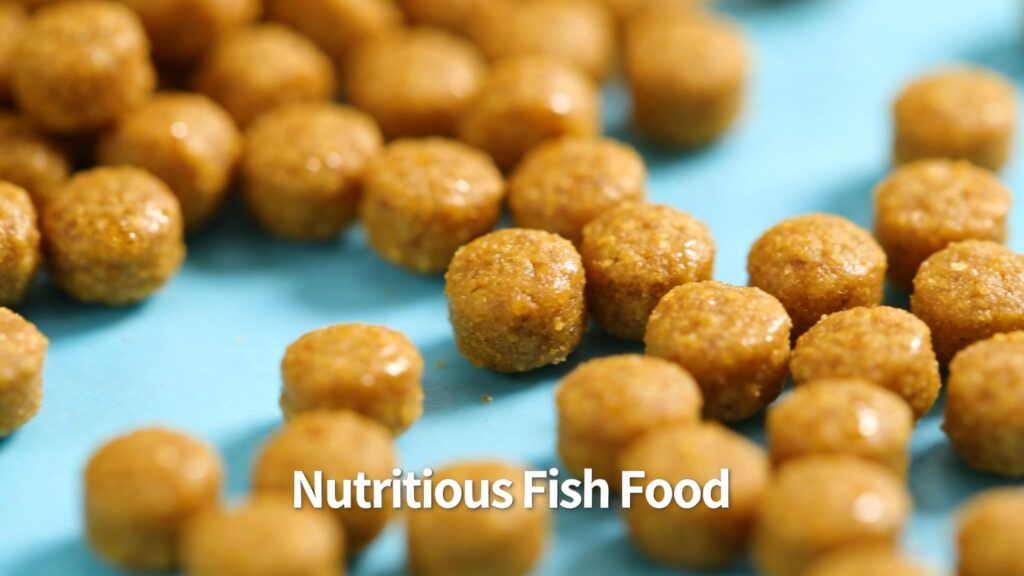
2. The Two Main Processing Routes
Pet food manufacturing falls into two broad categories, each with distinct processes:
| Type | Processing Method | Examples |
|---|---|---|
| Dry pet food (kibble) | Extrusion | Most dry dog and cat foods |
| Wet pet food (canned) | Retort processing (canning) | Canned stews, pâtés, chunks in gravy |
A growing third category includes freeze-dried, dehydrated, and cold-pressed products, often positioned as “minimally processed.”
Part I: How Dry Kibble Is Made
Step 1: Ingredient Receiving and Grinding
Bulk ingredients arrive by truck or rail and are stored in silos or bins. Whole grains and protein meals are fed through hammer mills to reduce particle size to a uniform 300–800 microns. Fine grinding improves digestibility and ensures consistent expansion during extrusion.
Step 2: Batching and Mixing
All dry ingredients are weighed according to the formulation recipe using a computerized batching system. They are then blended in a ribbon mixer or paddle mixer for 3–8 minutes. Liquid ingredients (fats, water, steam) are added at this stage or later in the process.
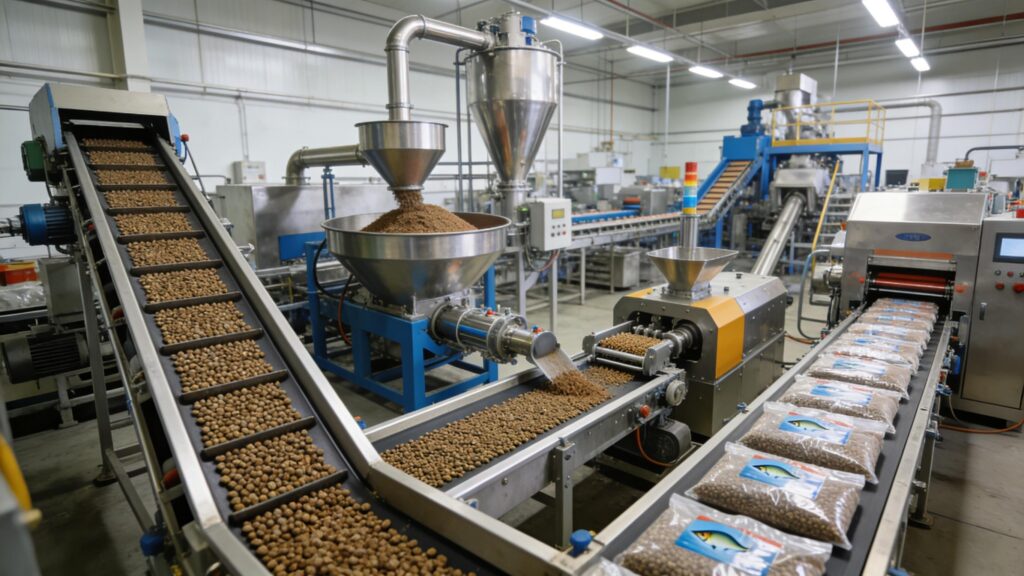
Step 3: Conditioning
The blended mixture enters a steam conditioner, where:
- Steam and water are injected
- Temperature rises to 80–100°C (176–212°F)
- Moisture increases to 25–30%
- Residence time: 30–120 seconds
Conditioning begins the process of starch gelatinization, which is essential for digestibility and pellet structure.
Step 4: Extrusion — The Heart of Kibble Making
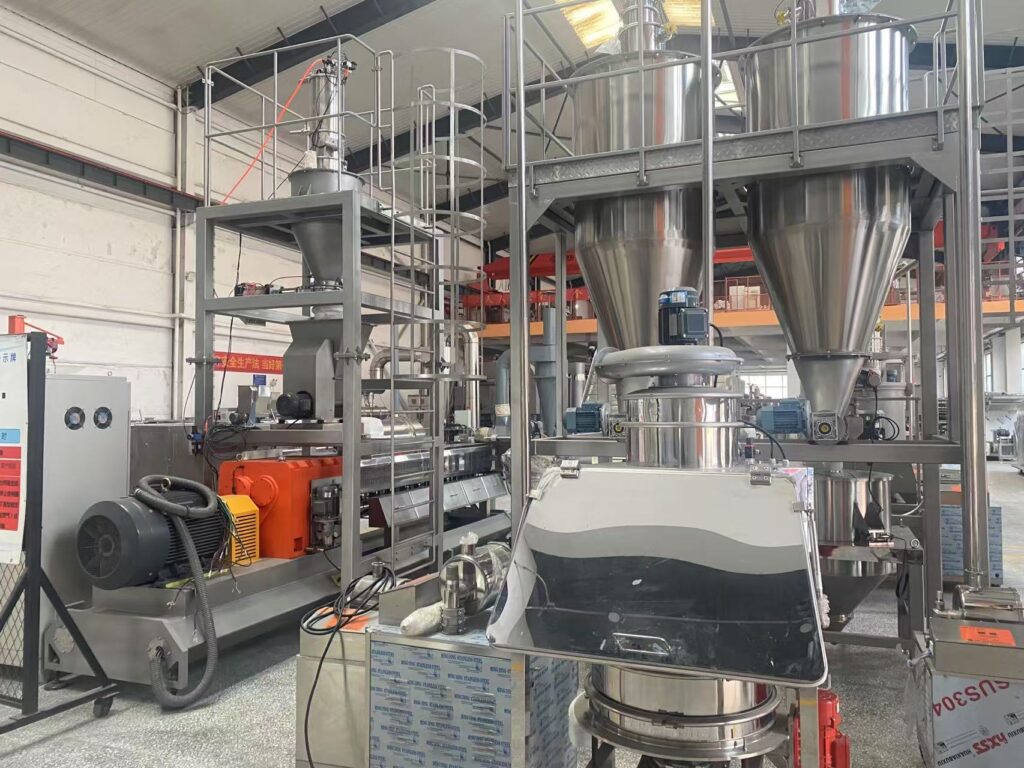
The conditioned mash is fed into an extruder—either a single-screw or twin-screw machine. This is where kibble truly takes shape.
Inside the Extruder:
- Conveying: The screws push material forward.
- Shear and heat: Mechanical energy and external barrel heaters raise the temperature to 120–150°C (248–302°F) under high pressure (30–60 bar).
- Cooking: Starches fully gelatinize; proteins denature.
- Expansion: As the dough exits through a die plate, the sudden pressure drop causes superheated water to flash into steam, expanding the kibble into its characteristic shape and porous structure.
The die plate determines kibble shape—round, triangular, bone-shaped, or custom designs. A rotating knife cuts the extrudate to the desired length.
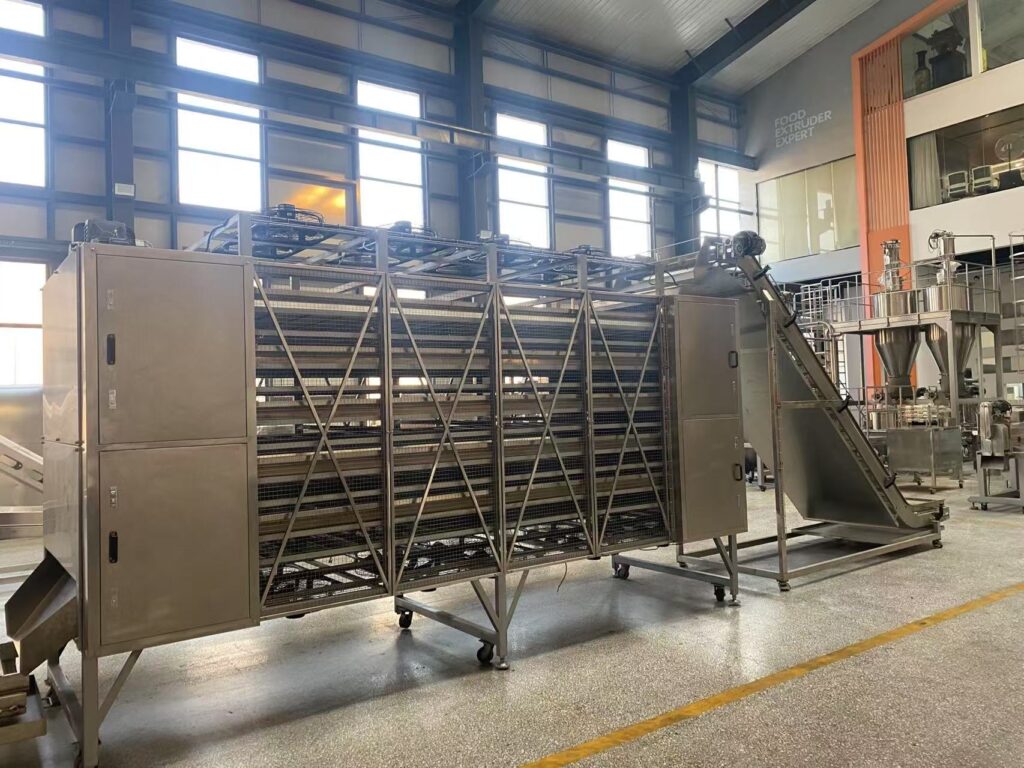
Step 5: Drying
Freshly extruded kibble contains 20–30% moisture—too high for storage stability. It moves through a multi-deck belt dryer or rotary dryer:
- Temperature: 90–150°C (194–302°F)
- Residence time: 15–40 minutes
- Final moisture: 8–10%
Proper drying prevents mold growth and ensures a shelf life of 12–18 months.
Step 6: Coating
After drying, kibble enters a coating drum or batch coater:
- Fats and oils are sprayed onto the rotating kibble.
- Palatability enhancers (digests, flavorings) are applied to make the food more appealing to pets.
- Some manufacturers use vacuum coating to allow higher fat inclusion without making the surface greasy.
Coating typically adds 5–15% fat to the finished product.
Step 7: Cooling and Packaging
- Kibble is cooled to ambient temperature in a counter-flow cooler.
- Sieves remove fines (dust and broken pieces), which are often recycled.
- Finished kibble is packaged in bags ranging from small trial sizes to 50-pound bulk bags, often under nitrogen flush or modified atmosphere packaging to preserve freshness.
Part II: How Wet (Canned) Pet Food Is Made
Canned pet food follows a fundamentally different process designed for high moisture content (typically 75–85%) and long shelf stability.
Step 1: Ingredient Preparation
Meats, poultry, fish, and vegetables are received fresh or frozen. They are:
- Ground to uniform particle size
- Blended with grains, vitamins, minerals, and gelling agents (such as guar gum or carrageenan)
- Mixed into a slurry or chunky mixture depending on the product style
Step 2: Filling
The mixture is pumped into empty cans or pouches. The filling process is carefully controlled to ensure:
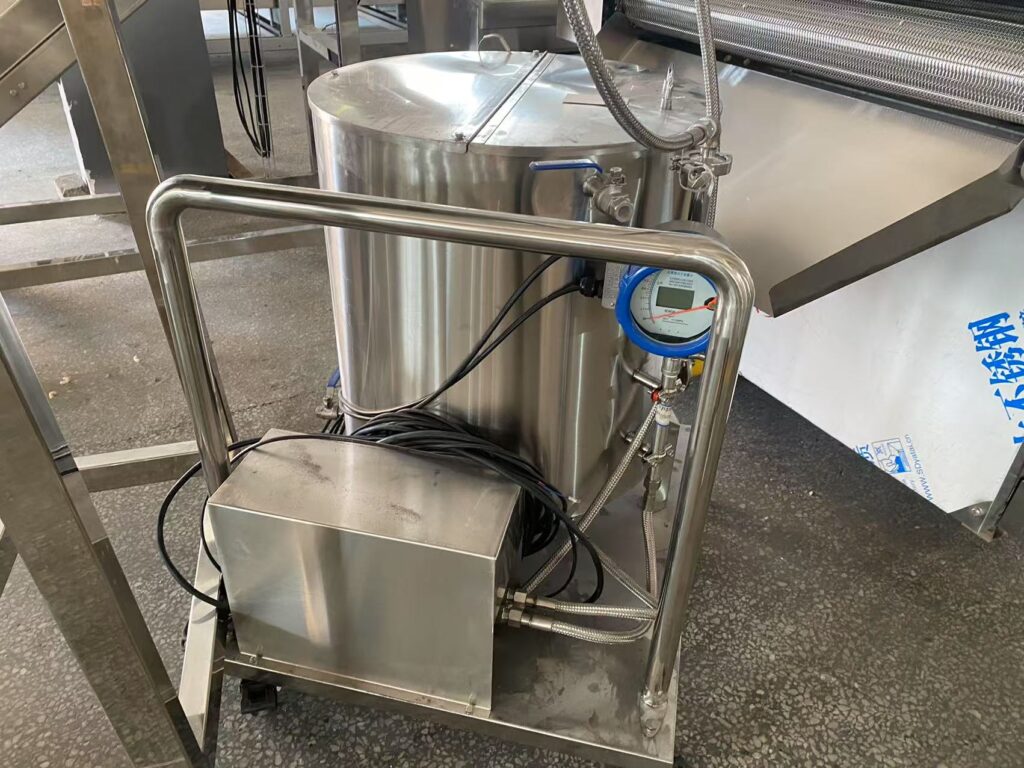
- Correct fill weight
- Proper headspace (the empty space at the top of the can) to allow for expansion during processing
- Minimal contamination
Step 3: Retort Sterilization (The Critical Step)
Sealed cans are loaded into a retort—a large pressure cooker capable of reaching high temperatures under pressure.
- Temperature: 121–130°C (250–266°F)
- Pressure: 15–30 psi
- Time: 30–90 minutes depending on can size and product density
This process:
- Sterilizes the contents, eliminating pathogens like Clostridium botulinum
- Cooks the food
- Creates a commercially sterile product that can be stored unrefrigerated for 2–5 years
Step 4: Cooling and Labeling
After retorting, cans are cooled with water spray or immersion, then dried, labeled, and packed into cases.
Part III: Emerging Processing Technologies
Consumer demand for “minimally processed” pet food has driven innovation in alternative processing methods:
| Technology | Description | Benefits |
|---|---|---|
| Cold pressing | Ingredients are compressed at low temperature without pre-cooking | Retains heat-sensitive nutrients; less processed appearance |
| Freeze-drying | Raw or cooked food is frozen then dried under vacuum | Preserves nutrients; light weight; no refrigeration needed |
| Gentle air drying | Low-temperature drying over extended periods | Maintains natural texture; minimal nutrient degradation |
| High-pressure processing (HPP) | Uses ultra-high water pressure to eliminate pathogens without heat | Preserves raw characteristics; used for refrigerated fresh foods |
4. Quality Control: What Testing Ensures
Pet food manufacturers employ extensive quality control protocols:
| Test | Purpose | Typical Standard |
|---|---|---|
| Nutritional analysis | Verify protein, fat, fiber, moisture levels | Matches guaranteed analysis |
| Pathogen testing | Screen for Salmonella, Listeria, E. coli | Zero tolerance for pathogens |
| Mycotoxin screening | Detect mold toxins in grains | Below FDA/regulatory limits |
| Palatability testing | Ensure pets will eat the food | Controlled feeding trials |
| Digestibility trials | Confirm nutrient absorption | ≥80% digestibility typical |
| Shelf-life testing | Verify stability over time | 12–24 months depending on format |
Many premium brands conduct AAFCO feeding trials, where the food is fed to actual dogs or cats to confirm it meets nutritional adequacy claims—a higher standard than simply formulating to meet nutrient profiles.
5. The “Human Grade” Debate
One frequently misunderstood term is “human grade.” For a pet food to legally claim human-grade status in the U.S.:
- All ingredients must be human-edible and stored under human-food handling conditions.
- The entire manufacturing process must meet USDA standards for human food production.
- This is exceptionally rare in the pet food industry; most products use ingredients not certified for human consumption but perfectly safe for pets.
The more common term “human quality” has no legal definition and is primarily a marketing phrase.
6. Complete Manufacturing Flow (Dry Kibble)
Raw Materials
      ↓
Grinding (Hammer Mill)
      ↓
Batching (Computerized Weighing)
      ↓
Mixing (Ribbon/Paddle Mixer)
      ↓
Conditioning (Steam Conditioner)
      ↓
Extrusion (Single or Twin-Screw Extruder)
      ↓
Drying (Multi-Deck Belt Dryer)
      ↓
Coating (Coating Drum)
      ↓
Cooling (Counter-Flow Cooler)
      ↓
Sieving (Vibratory Sieve)
      ↓
Packaging (Bagging Machine)
      ↓
Quality Control Testing
      ↓
Warehousing & Distribution
7. Common Misconceptions vs. Reality
| Misconception | Reality |
|---|---|
| “By-products are low-quality fillers” | By-products (organs, tissues) are often highly nutritious sources of vitamins and minerals that wild animals would consume |
| “Corn is just a cheap filler” | Corn provides digestible energy, essential fatty acids, and is a good source of carbohydrates when properly processed |
| “Grain-free means better” | Grain-free formulations replace grains with other carbohydrates (potatoes, peas); not inherently superior and has been linked to canine dilated cardiomyopathy (DCM) concerns |
| “Fresh meat is always better than meal” | Meat meal is concentrated protein; fresh meat contains high moisture that cooks off, so a “chicken first” ingredient may not represent the highest protein content after processing |
8. Sustainability Trends in Pet Food Processing
The pet food industry is increasingly addressing environmental impact:
- Alternative proteins: Insect meal (black soldier fly larvae), cultured meat, and plant-based proteins
- Upcycled ingredients: Using by-products from human food production that would otherwise go to waste
- Energy efficiency: Heat recovery systems in extruders and dryers
- Sustainable packaging: Recyclable bags, reduced plastic, and mono-material packaging for easier recycling
Final Thoughts
Pet food processing is far more sophisticated than simply “mixing ingredients in a bag.” From the precise engineering of extrusion to the sterilization science of retort cooking, each step is carefully designed to produce a safe, nutritious, and palatable product.
Understanding how pet food is made empowers consumers to make informed choices—whether selecting a traditional kibble, exploring wet food options, or considering minimally processed alternatives. The next time you pour a bowl of kibble or open a can, you’ll know the complex journey those ingredients took to reach your pet’s bowl. If you are interested in the pet food making machine , you can contact me , i will give you good advice and solutions .
1.Will you help us with the installation ?
Yes , We will send engineers to install and debug the equipment, and assist in training your staff.
2.Are you a factory or trading company?
We are a factory.
3.What certificate do you have?
We have ISO and CE certificate.
4.How long is the warranty period?
All of our machines have one year warranty.
5.What’s the main market of your company?
Our customers all over the world.
6.How much production capacity of your company one year?
This depends on your needs.
 Italian
  English
  Russian
  Spanish
  Arabic
  Portuguese
  German
  French
  Japanese
  Moroccan Arabic
  Persian
  Belarusian