Investing in a fish feed (aquafeed) production line requires more than just one machine. A complete line is a system that handles raw materials, grinding, mixing, forming (pelleting or extrusion), drying/cooling, coating, sizing, packaging, and dust control. The exact equipment depends on whether you produce sinking pellets ou floating/slow-sinking extruded feed, your target capacity, and how automated you want the plant to be.
Below is a practical, equipment-focused overview.
1) Raw Material Receiving & Storage
Purpose: receive, store, and dose ingredients safely and consistently.
Typical equipment:
- Truck/Bag unloading system (bag dump station, big-bag unloader)
- Storage silos or bins (for corn, soybean meal, wheat flour, etc.)
- Micro-ingredient bins (vitamins, minerals, additives)
- Conveyors & elevators (screw conveyors, belt conveyors, bucket elevators)
- Weighing & batching system (load cells, batching scales)
2) Cleaning & Pre-Processing
Purpose: protect downstream machines and improve product quality.
Typical equipment:
- Magnet / magnetic separator (remove metal)
- Vibrating screen / sifter (remove stones and oversized impurities)
- Destoner (optional but useful for bulk grains)
- Pre-crusher (optional for large chunks)
3) Grinding (Size Reduction)
Purpose: achieve the particle size required for fish digestion and pellet stability.
Typical equipment:
- Hammer mill (most common; versatile, high throughput)
- Fine grinder / pulverizer (for very small pellets and some juvenile fish diets)
- Cyclone + dust collector (reduce dust, recover fines)
- Airlock & aspiration system (for stable milling and cleanliness)
Note: Smaller fish and higher-performance feeds often require finer grinding.
4) Mixing & Liquid Addition
Purpose: ensure uniform nutrition in every pellet.
Typical equipment:
- Batch mixer (single-shaft paddle, double-shaft paddle, ribbon mixer)
- Micro-dosing system (for premix, amino acids, enzymes)
- Liquid addition system (oil, lecithin, molasses, binders) with:
- tanks, pumps, flow meters, spray nozzles
- Pre-mixer (optional for premixes)
5) Conditioning (Heat & Moisture Treatment)
Purpose: improve pellet quality, gelatinize starch, and prepare for forming.
Typical equipment:
- Steam conditioner (single or double conditioner)
- Steam boiler + piping + valves (critical utility)
- Water dosing system (when needed for moisture control)
Conditioning is essential for both pelleting and extrusion, but extrusion typically uses more intensive conditioning.
6) Forming: Pellet Mill or Extruder (Key Decision)
A) For sinking feed (common for many grow-out stages)
Typical equipment:
- Pellet mill (ring die is common for industrial scale; flat die for smaller scale)
- Die and roller sets (multiple sizes for different pellet diameters)
- Feeder and forced feeder (for stable throughput)
B) For floating/slow-sinking feed (popular for many aquaculture species)
Typical equipment:
- Twin-screw or single-screw extruder (twin-screw offers better control for high-fat and complex formulas)
- Pre-conditioner (often larger/dual-stage)
- Extruder die set (controls shape, size, density)
- Cutter assembly (controls pellet length)
Extrusion allows control of buoyancy (floating vs. sinking) by changing expansion and density.
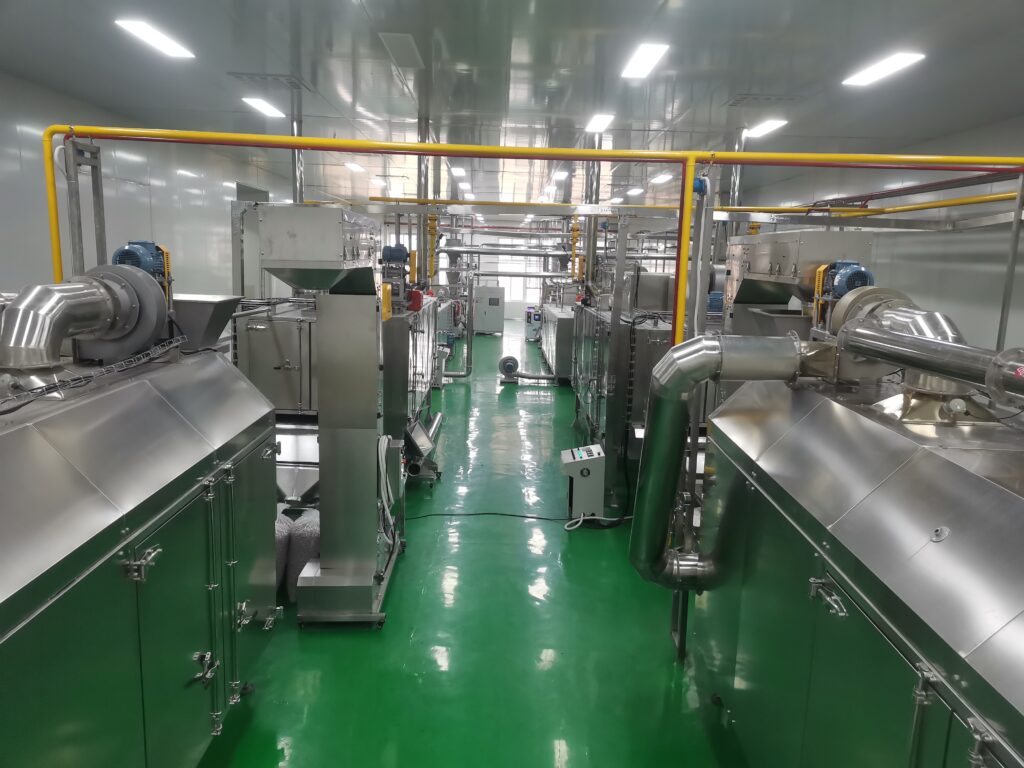
7) Drying (Especially for Extruded Feed)
Purpose: reduce moisture to safe storage levels and stabilize pellets.
Typical equipment:
- Belt dryer / multi-layer conveyor dryer
- Air heater / burner system (gas, diesel, steam heat exchanger)
- Moisture monitoring instruments
Extruded feed almost always needs a dryer; pelleted feed may use cooling mainly, depending on moisture.
8) Cooling
Purpose: cool pellets to near ambient temperature and prevent mold.
Typical equipment:
- Counterflow cooler (industry standard)
- Cooler air fan + cyclone/dust collector
- Rotary valve/airlock (to maintain airflow control)
9) Crumbling & Sizing (For Small Fish Feed)
Purpose: make smaller particle sizes without making powder.
Typical equipment:
- Crumble machine (crumbler) (for fry/juvenile feed)
- Sifter / grading screen (separates by size)
- Recycle system (return oversize to crumbler; return fines to rework)
10) Coating (Oil/Fat/Vitamins Post-Processing)
Purpose: increase energy density, palatability, and deliver heat-sensitive additives.
Typical equipment:
- Drum coater / vacuum coater
- Oil tanks, heated lines, pumps, spray bars
- Weighing/control system (accurate coating rate)
Vacuum coating is often preferred for high-oil aquafeeds because it improves absorption and reduces surface greasiness.
11) Packaging & Finished Goods Handling
Purpose: deliver consistent product formats for customers.
Typical equipment:
- Automatic weighing and bagging machine (10–50 kg) or small pack system (1–5 kg)
- Bag sewing/sealing machine
- Inkjet/date coder
- Palletizer + stretch wrapper (optional)
- Finished product bins and conveyors
12) Dust Control, Safety, and Utilities (Often Overlooked)
These items are essential for reliable operation and compliance:
- Central dust collection system (baghouse, ducting)
- Explosion protection (where required: explosion vents, isolation valves)
- Air compressor (pneumatics)
- Electrical system (MCC cabinets, VFD drives, PLC/SCADA automation)
- Water system (process water, boiler feed water treatment)
- Lab/QC tools (moisture analyzer, pellet durability tester, sieve set)
Summary: A Typical Equipment List (Quick Checklist)
- Receiving/storage: bins/silos, conveyors, batching scales
- Cleaning: magnets, screens, destoner
- Grinding: hammer mill + dust collection
- Mixing: mixer + micro-dosing + liquid addition
- Conditioning: steam conditioner + boiler
- Forming: pellet mill ou extrudeuse
- Drying (mainly for extruded): belt dryer
- Cooling: counterflow cooler
- Sizing: crumbler + sifter
- Coating: drum/vacuum coater + oil system
- Packaging: weighing, bagging, sealing, palletizing
- Utilities/safety: dust control, electrics/PLC, air compressor, QC lab
 French
  English
  Russian
  Spanish
  Italian
  Arabic
  Portuguese
  German
  Japanese
  Moroccan Arabic
  Persian
  Belarusian