
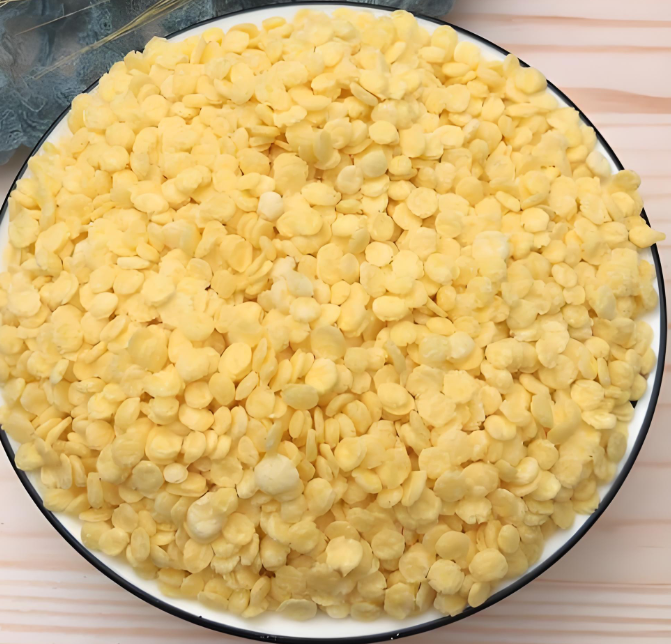
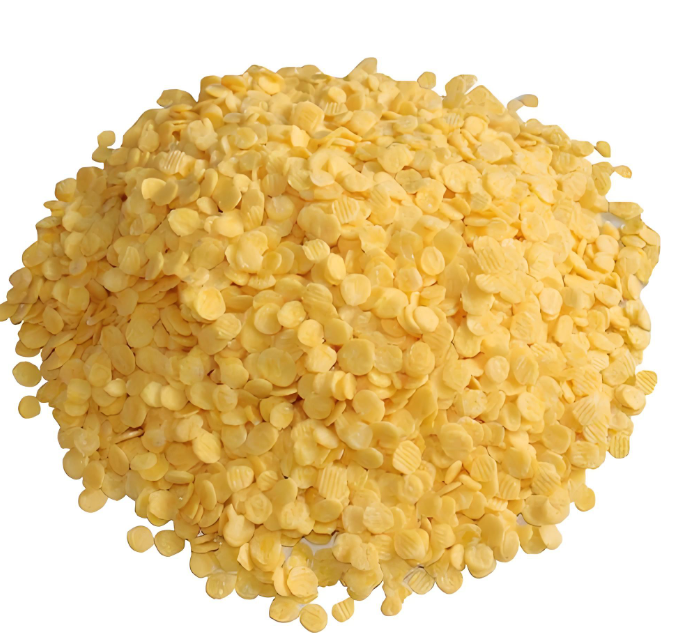
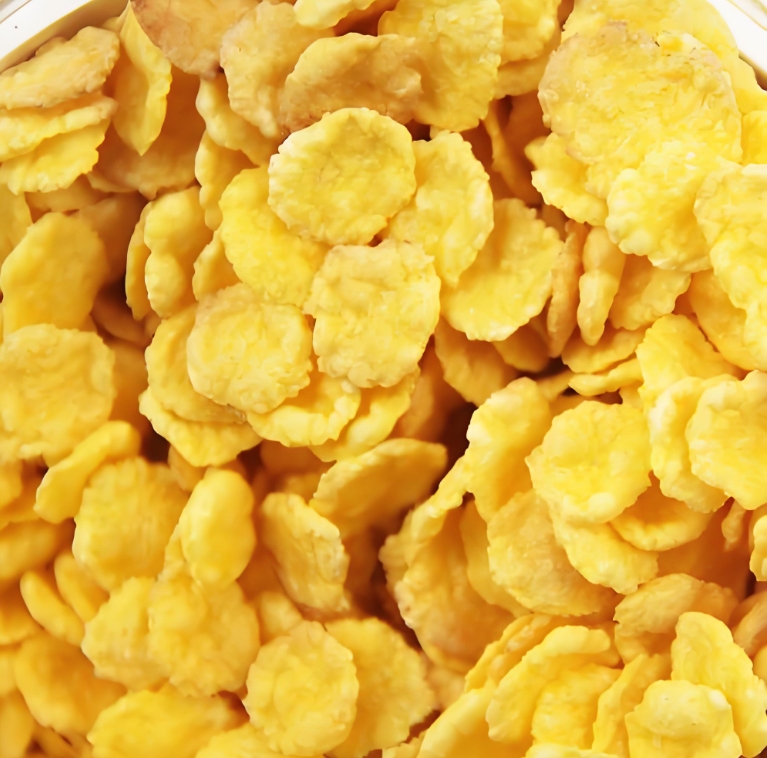
The drying stage in breakfast corn flake production is arguably the most critical transformation point where the soft, corn flakes manufacturing machine moist flakes from the flaking rolls develop their characteristic light, crispy texture and signature golden color. This process goes far beyond simple moisture removal—it is a precisely controlled thermal operation that sets the final product’s structure, taste, and shelf life.
The Purpose and Science of Drying
After being flattened through flaking rolls, corn flakes contain approximately 28-35% moisture and possess a soft, pliable structure. The drying process serves multiple essential functions:
- Moisture Reduction: Achieves a final moisture content of 1-3% for optimal crispness and microbial stability
- Structural Setting: Rapidly gelatinizes and sets the starch matrix, creating the rigid, porous structure
- Flavor Development: Initiates Maillard browning reactions and caramelization for flavor and color
- Volume Expansion: Causes steam generation that “puffs” the flakes slightly, enhancing lightness
Equipment and Configuration
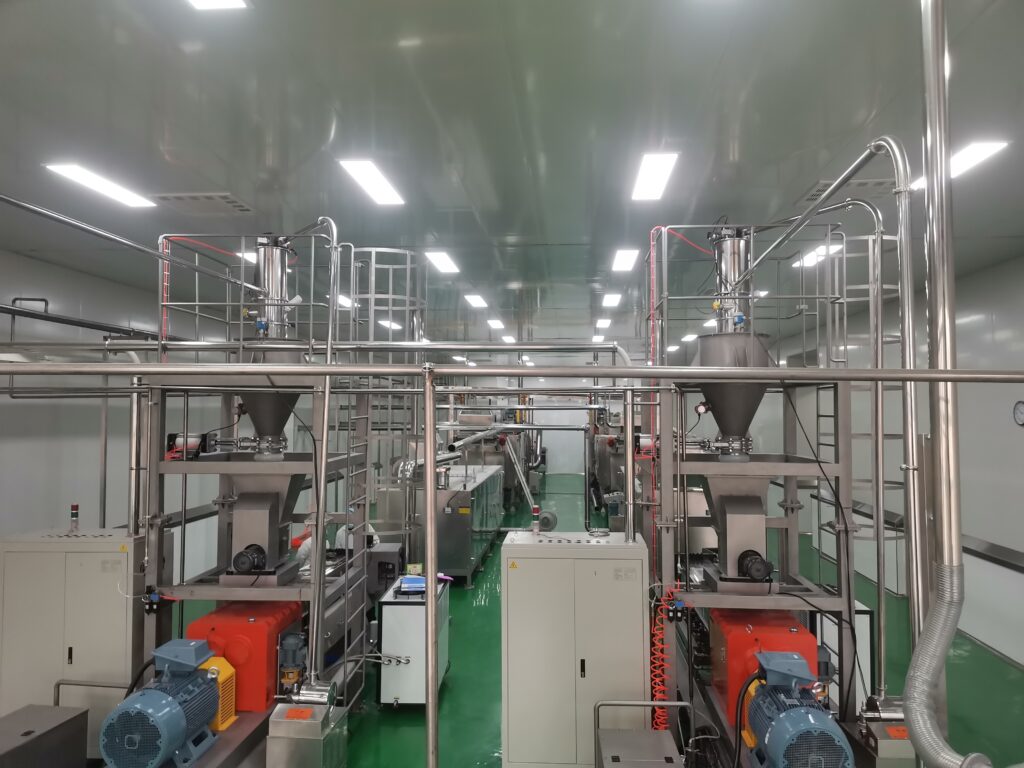
Industrial corn flake drying typically employs multi-zone conveyor dryers (often called “towers” or “tunnel ovens”) with the following features:
- Longueur: 12-30 meters, allowing sufficient residence time (typically 2-4 minutes total)
- Zoning: Divided into 3-5 independently controlled temperature zones
- Airflow: High-velocity (1.5-3 m/s) hot air applied perpendicularly (cross-flow) or vertically
- Conveyor: Perforated stainless steel belts or mesh allowing air penetration from both sides
- Heat Source: Direct gas-fired, indirect steam, or electric heating systems
The Multi-Stage Drying Profile
Stage 1: Rapid Surface Drying (Initial Zone)
- Temperature: 260-320°C (500-608°F)
- Time: 20-45 seconds
- Purpose: Immediate surface moisture removal creates a semi-permeable “skin,” corn flakes manufacturing machine preventing sticking while allowing internal steam to escape. This rapid heating initiates starch gelatinization at the surface.
Stage 2: Puffing and Structural Set (Main Zone)
- Temperature: 180-230°C (356-446°F)
- Time: 60-90 seconds
- Purpose: Internal moisture turns to steam, expanding the flake’s structure. The starch fully gelatinizes then begins to retrograde, forming the rigid matrix. Flakes achieve approximately 50% of their volume increase here.
Stage 3: Browning and Flavor Development (Intermediate Zone)
- Temperature: 140-180°C (284-356°F)
- Time: 30-60 seconds
- Purpose: Maillard reactions between amino acids and reducing sugars create golden-brown color and the characteristic toasted cereal flavor. Caramelization of added sugars occurs.
Stage 4: Final Moisture Equalization (Finishing Zone)
- Temperature: 100-130°C (212-266°F)
- Time: 30-45 seconds
- Purpose: Gently removes the last percentages of moisture while allowing internal moisture to equilibrate, preventing “case hardening” where the exterior becomes too impermeable.
Stage 5: Cooling (Post-Dryer)
- Temperature: Ambient to 40°C (104°F)
- Purpose: Stops all thermal reactions, prevents condensation in packaging, and prepares flakes for coating or packaging.
Critical Control Parameters
- Moisture Monitoring
- In-line near-infrared (NIR) sensors continuously measure moisture content
- Target exit moisture: 2.0-3.0% (slightly higher than final product to account for equilibration)
- Laboratory validation every 30-60 minutes using oven drying methods
- Airflow Management
- Air velocity must be uniform across the entire belt width (±10%)
- Static pressure maintained consistently to ensure even heat distribution
- Humidity control in recirculated air to prevent over-drying in final stages
- Temperature Profiling
- Thermocouples positioned at multiple heights above and below conveyor
- Zone temperatures adjusted based on flake thickness and ingredient variations
- Typical temperature gradient: 320°C → 200°C → 160°C → 120°C
- Residence Time Control
- Conveyor speed typically 0.5-2 meters/minute depending on dryer length
- Adjustments made based on flake size and incoming moisture content
Advanced Techniques and Innovations
Variable-Zone Drying
- Different temperature profiles for flakes of varying thickness across the conveyor width
- Achieved through segmented airflow control systems
Humidity-Controlled Drying
- Monitoring and adjusting the dew point in drying air
- Particularly important in final stages to prevent excessive brittleness
Combined Microwave-Convection Systems
- Microwaves penetrate to quickly remove internal moisture
- Hot air provides surface drying and browning
- Reduces drying time by 30-40%
Real-Time Color Monitoring
- Computer vision systems analyze flake color continuously
- Automatically adjust zone temperatures to maintain consistent browning
Quality Indicators and Troubleshooting
| Quality Parameter | Ideal Result | Common Issue | Corrective Action |
|---|---|---|---|
| Color | Uniform golden brown | Pale flakes | Increase Stage 2-3 temperatures |
| Texture | Crisp, light snap | Hard, glassy texture | Reduce Stage 1 temperature, increase humidity |
| Bulk Density | 0.12-0.18 g/cm³ | Too dense | Increase Stage 2 temperature for more puffing |
| Bowl Life | Remains crisp >3 minutes in milk | Becomes soggy quickly | Ensure final moisture <3%, check starch retrogradation |
| Flake Integrity | 85-95% whole flakes | Excessive breakage | Reduce temperature differential between zones |
Energy Efficiency Considerations
Modern corn flake dryers incorporate several energy-saving features:
- Heat Recovery Systems: Capture exhaust heat to preheat incoming air (40-60% recovery possible)
- Insulated Construction: High-efficiency insulation minimizes thermal losses
- Variable Frequency Drives: On fans and conveyors to match production rates
- Direct Fired Burners: With precise air/fuel ratio controls for maximum efficiency
The Role of Drying in Product Differentiation
The drying process can be manipulated to create different product characteristics:
- “Extra Crispy” Variants: Longer residence time in Stage 2 with higher temperatures
- “Light” Versions: Higher Stage 2 temperatures for greater puffing, resulting in lower density
- “Slow-Roasted” Premium Products: Extended lower-temperature drying (180-200°C) for 5-8 minutes
- Sugar-Coated Flakes: Slightly higher exit moisture (3.5-4%) to improve syrup adhesion before final drying
The drying of breakfast corn flakes represents a perfect synergy of food science and engineering. corn flakes manufacturing machine By carefully controlling the transition of moisture through different physical states and inducing precisely timed chemical reactions, manufacturers transform a simple flattened grit into an iconic breakfast staple with consistent quality, appealing texture, and satisfying flavor. The ongoing evolution of drying technology continues to drive improvements in energy efficiency, product consistency, and the creation of new textural experiences for consumers worldwide.
 French
  English
  Russian
  Spanish
  Italian
  Arabic
  Portuguese
  German
  Japanese
  Moroccan Arabic
  Persian
  Belarusian