
Behind the Plant-Based Veil: The Industrial Processing of Meat Alternatives
The rise of plant-based meat alternatives represents a significant shift in global food culture. Marketed as wholesome, sustainable, and ethical choices, these products often carry an aura of simplicity—seemingly just mashed beans or grains shaped into a patty. However, the reality of creating convincing meat analogs—with the precise texture, flavor, and appearance of animal protein—involves a complex, multi-step industrial process far removed from whole foods. This article unveils the complete manufacturing journey of a typical high-protein plant-based meat product, such as a burger or ground “beef” analog.
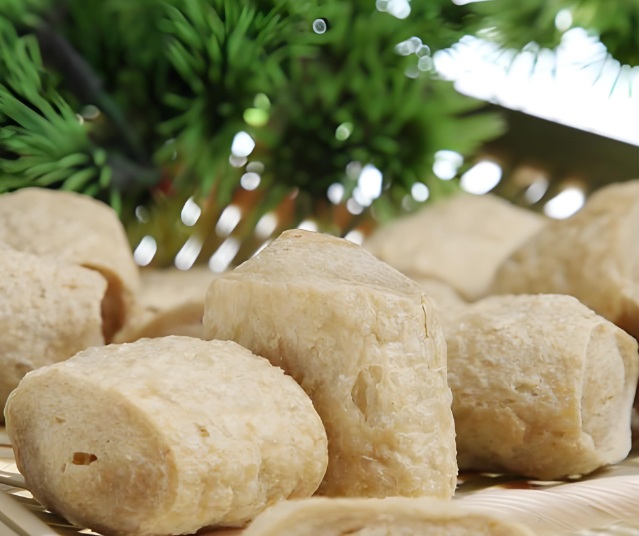
Phase 1: Raw Material Sourcing & Protein Isolation
The journey begins not with a whole plant, but with its refined components.
- Core Protein Source: The primary ingredient is often soy protein isolate (SPI), pea protein isolate (PPI), or wheat gluten (vital wheat gluten). These are not simple flours.
- Isolation Process (Using Soy as an Example):
- Defatting: Soybeans are cleaned, dehulled, and rolled into flakes. The oil is extracted using hexane or mechanical pressing, leaving defatted flakes.
- Solvent Extraction & Washing: The flakes are washed with water and alcohol to remove sugars (oligosaccharides like stachyose and raffinose, which cause flatulence) and soluble carbohydrates.
- Precipitation & Neutralization: The protein is solubilized in an alkaline solution and then precipitated at an acidic pH (the isoelectric point).
- Drying: The resulting protein curd is neutralized, pasteurized, and spray-dried into a fine, bland-tasting powder containing 90%+ protein.
Phase 2: The Formulation & Functional Mix
The protein isolate is just the canvas. A slurry or dry mix is created with precise additions:
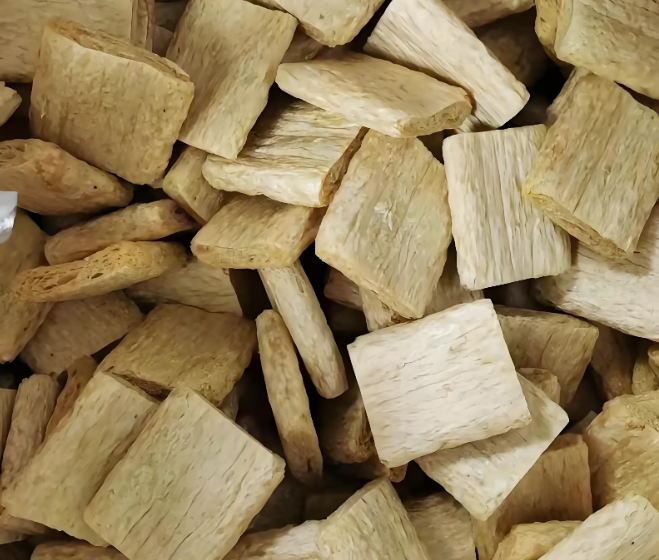
- Binders & Texturizers: Methylcellulose or hydrocolloids (e.g., gellan gum, carrageenan) are crucial. They mimic the binding property of animal myosin, holding water and fat during cooking to prevent disintegration.
- Flavor Systems: A complex blend is added to mask the “beany,” “green,” or “earthy” notes of the base protein and create a savory, meaty, and sometimes “bloody” profile. Key components include:
- Yeast Extracts: For umami and savory depth.
- Leghemoglobin (Heme): A genetically engineered or plant-derived iron-containing molecule (notably from Impossible Foods) that provides a meat-like color and metallic/bloody flavor when cooked.
- Volatile Compounds: Isolated from plants or synthesized to replicate the specific aroma of grilled, fried, or roasted meat.
- Salt, Spices, and Sugar: For basic taste enhancement and browning.
- Fat System: Refined plant oils (coconut, sunflower, canola) are often pre-solidified or encapsulated to mimic the solid fat (marbling) of animal meat that melts during cooking, providing juiciness.
- Colorants: Beetroot extract, annatto, or other natural colorants give the raw product a red/pink hue. Heme serves this purpose as well. Some systems use pH-sensitive colorants that change during cooking, mimicking the doneness transition of beef.
Phase 3: The Key Transformation: High-Shear Mixing & Extrusion
This is where texture is born. The dry ingredients and water are combined to form a viscous dough or paste.
- High-Shear Mixing: Intense mechanical energy aligns and stretches the long protein chains, beginning to develop a fibrous structure.
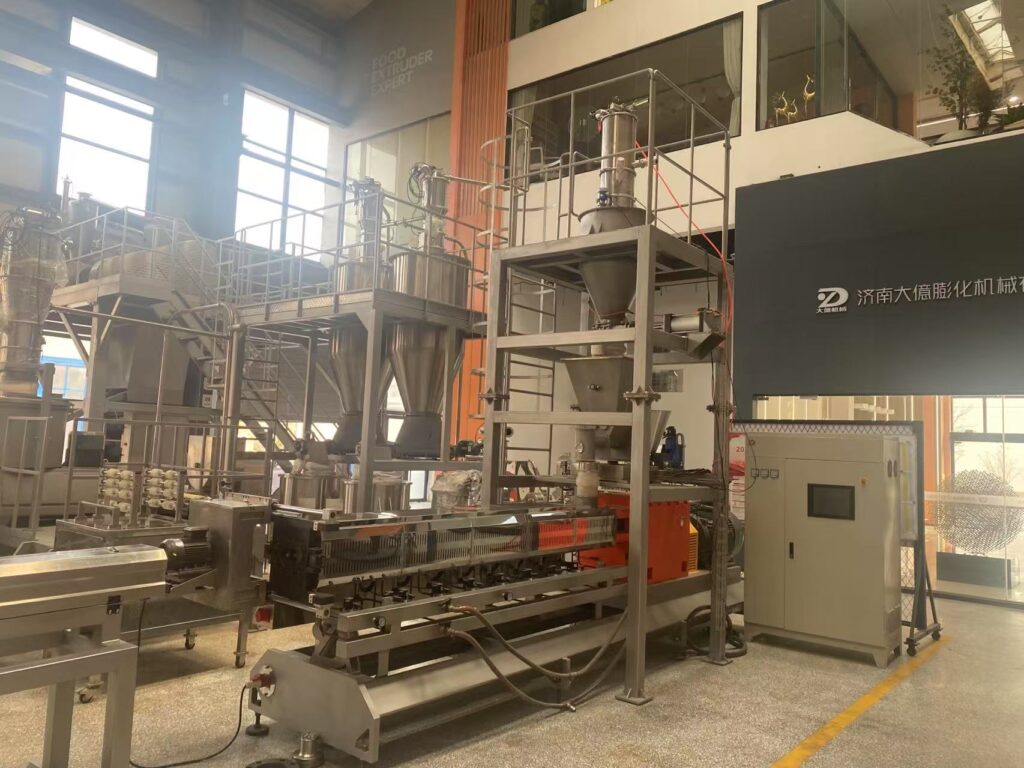
- Thermo-Mechanical Extrusion (The Critical Step): The dough is fed into a twin-screw extruder. It is subjected to controlled:
- Heat
- Pressure
- Moisture
- Intense Mechanical Shear
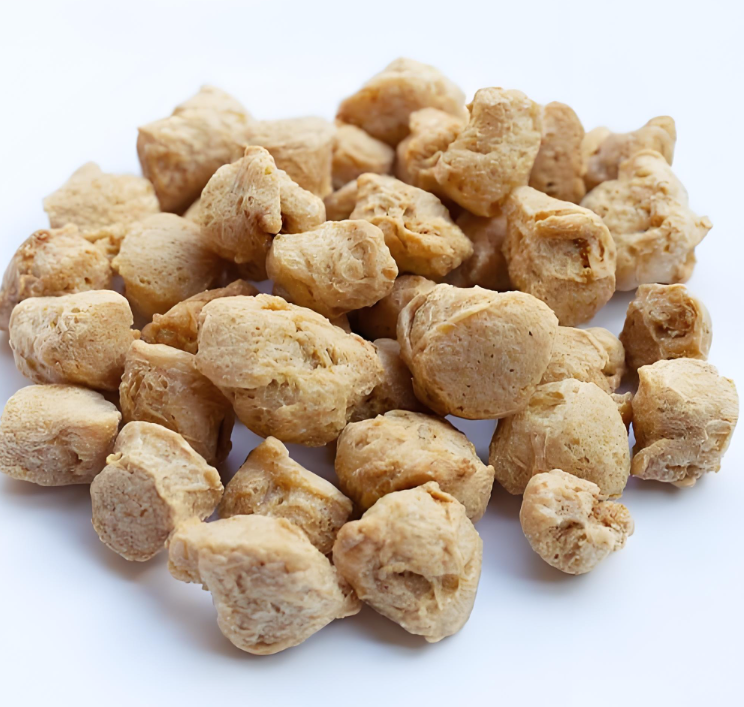
As the mixture is forced through a long barrel and out through a specialized die, the proteins denature and cross-link. The sudden pressure drop at the die causes steam explosion, creating a layered, fibrous, and spongy matrix that closely mimics the muscle fiber structure of animal meat. The product exiting the extruder—an expanded, porous “mass”—is called a “high-moisture meat analog” or a dry, spongy chunk that can be rehydrated.
Phase 4: Post-Processing & Assembly
- Shaping & Forming: The extruded protein mass is finely ground or chopped and then mixed with the fat system, remaining flavorings, and binders. This final mixture is then formed into patties, nuggets, or logs via molding or pressing.
- Cooking/Setting: Products are typically steamed, grilled, or baked to set the structure, develop surface color, and pasteurize for food safety.
- Freezing & Packaging: Most products are flash-frozen to lock in structure and flavor, then packaged in modified atmosphere packaging to extend shelf life.
Phase 5: The Final Product: An Engineered Food System
The item in the freezer aisle is the result of this intensive processing. It is a deconstructed and reconstructed food system designed to satisfy specific sensory and cultural expectations of meat.
The Transparency Takeaway:
Understanding this process is not to demonize plant-based meats, which offer valid solutions for environmental and ethical concerns. Instead, it is to clarify their nature: they are ultra-processed food products (NOVA Group 4). Their production involves industrial methods, chemical and physical processing, and numerous additives to achieve their goal. For consumers, the choice is not between a simple bean patty and a beef burger, but between two technologically sophisticated products—one leveraging animal biology, the other leveraging food science. Informed choice requires seeing beyond the marketing to the complex, ingenious, and highly industrial reality of the modern meat alternative.
 Persian
  English
  Russian
  Spanish
  Italian
  Arabic
  Portuguese
  German
  French
  Japanese
  Moroccan Arabic
  Belarusian