
The cooling system is a critical yet often underappreciated component of an industrial extruder. While the extrusion process is fundamentally about applying thermal and mechanical energy to cook and shape materials, extruding machines precise heat removal is equally vital for machine protection, process stability, and final product quality. The cooling system’s role is to manage the excess heat generated, ensuring the extruder operates within its precise thermal window.
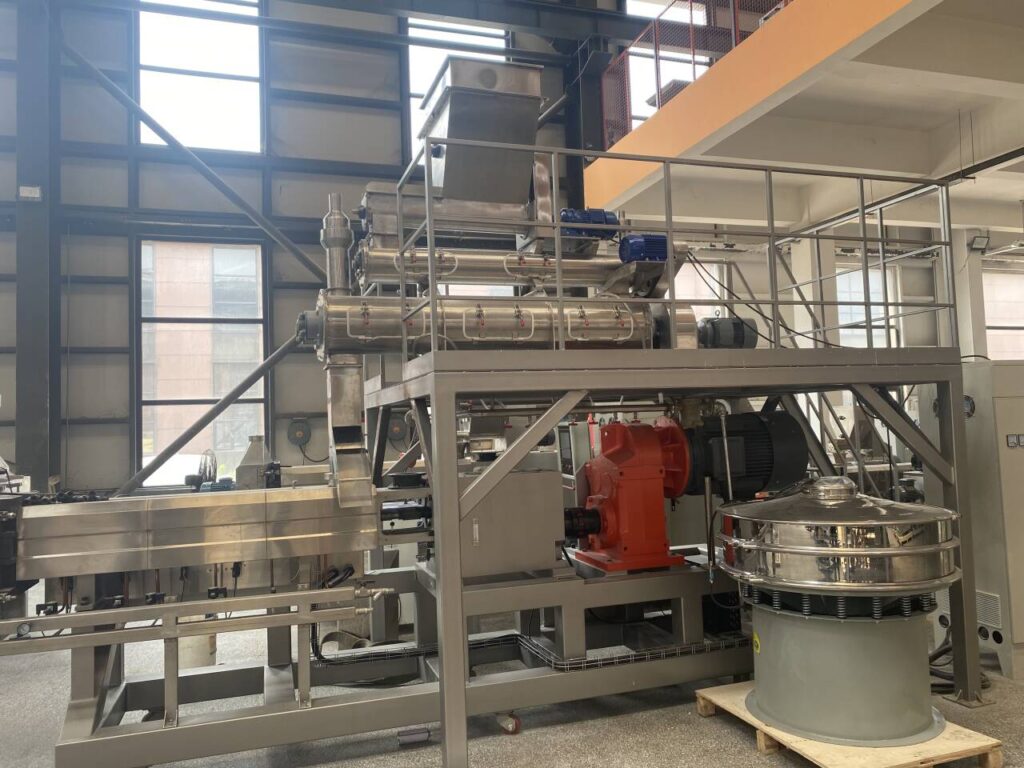
Primary Sources of Heat Requiring Cooling
Understanding what generates the heat is key to appreciating the cooling system’s function:
- Mechanical Shear Energy: The majority of heat in many extrusion processes (especially thermoplastic or high-shear cooking) comes from the mechanical energy input of the rotating screws against the viscous material. extruding machines This conversion of motor power into heat is substantial.
- External Heating: Barrel heaters provide initial and zonal heat to start the cooking process and maintain temperature profiles.
- Process Exotherms: Some chemical or gelatinization reactions within the ingredient mix itself can release additional heat.
Without effective cooling, extruding machines this heat would accumulate uncontrollably, leading to product degradation, volatile loss, undesirable texture, and potential equipment damage.
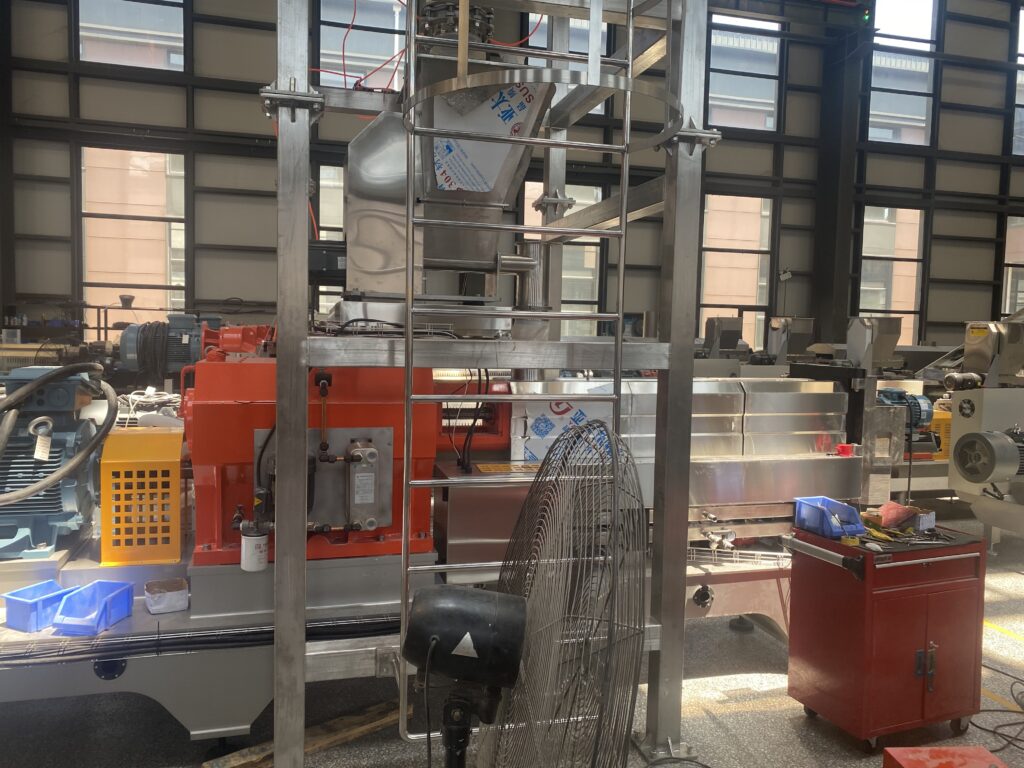
Key Components of an Extruder Cooling System
A comprehensive cooling system typically involves several integrated circuits:
1. Barrel Cooling:
The barrels, segmented into multiple zones, are equipped with external cooling jackets. These jackets circulate a cooling medium—typically water or thermal oil—around each barrel section.
- Method: Modern systems use solenoid valves or proportional valves controlled by the PLC. When a barrel zone’s temperature sensor exceeds its setpoint, the valve opens, allowing coolant to flow through that specific jacket, removing excess heat.
- Design: Flow paths (baffles) within the jacket are designed to ensure even cooling across the barrel’s circumference and length.
2. Screw Cooling (Internal Core Cooling):
In many extruders, especially for heat-sensitive materials, the screw shafts are hollow. A separate cooling circuit allows a temperature-controlled fluid (usually water) to flow through the core of the screw.
- Purpose: This prevents heat from the material from transferring into the screw shaft and the gearbox. extruding machines It helps maintain a steeper temperature gradient at the screw root, promoting better conveyance and preventing material from sticking or degrading on the screw surface.
- Challenges: It requires a rotary union or coupling at the drive end to introduce coolant into the rotating screw, making it a more complex and maintenance-sensitive subsystem.
3. Gearbox Cooling:
The massive gear reducer generates significant heat from friction between its high-load gears and bearings. A dedicated oil cooling circuit is standard.
- Method: Gearbox oil is circulated through an external oil-to-water heat exchanger. Coolant from the main plant supply removes heat from the oil, ensuring the gearbox operates within a safe temperature range (typically 45-65°C / 113-149°F). This is essential for maintaining oil viscosity, lubrication effectiveness, and gearbox longevity.
4. Bearing Housing Cooling:
The main thrust bearing assembly, which absorbs immense axial force, also generates frictional heat. Cooling jackets around the bearing housing are common to prevent overheating and premature bearing failure.
Types of Cooling Systems
- Once-Through (City Water) Systems: Simple but wasteful. Plant cooling water is used and discharged. Temperature control is coarse, dependent on incoming water temperature.
- Closed-Loop Chilled Water Systems: The industry standard for precise control. A central chiller cools a glycol-water mixture, which is then circulated in a closed loop to the extruder’s various cooling circuits. This provides consistent, low-temperature coolant regardless of ambient conditions.
- Temperature Control Units (TCUs): For very precise applications, dedicated TCUs may be used for critical zones (e.g., die adapters). These are compact, self-contained systems that combine a pump, heater, and cooler to maintain a fluid at an exact setpoint.
Control and Integration
The cooling system is not passive; it is an active, integral part of the process control loop.
- PID Control: Each barrel zone uses a Proportional-Integral-Derivative (PID) control algorithm to manage the interplay between heaters and the cooling solenoid valve, holding temperature within ±1°C.
- Process Stability: Proper cooling prevents thermal runaway, extruding machines where increasing heat reduces material viscosity, which reduces shear heat generation—a destabilizing cycle. Cooling maintains consistent melt viscosity.
- Product Quality: By controlling the final melt temperature before the die, cooling directly affects product expansion, moisture evaporation, texture, and shape definition.
The extruder cooling system acts as the essential thermal brake and stabilizer. It works in delicate counterbalance with the heating and mechanical energy inputs to maintain the precise thermodynamic equilibrium required for the extrusion process. extruding machines From protecting capital equipment like gearboxes and bearings to enabling the consistent production of high-quality puffed snacks, cereals, or pet food, effective cooling is not merely an auxiliary function—it is a foundational pillar of efficient, reliable, and precise extrusion operations.
 Persian
  English
  Russian
  Spanish
  Italian
  Arabic
  Portuguese
  German
  French
  Japanese
  Moroccan Arabic
  Belarusian