
1. Introduction
A twin-screw extruder is a continuous processing machine widely used in food, feed, and biomaterial industries for mixing, cooking, conveying, texturizing, and shaping materials under controlled heat and shear. Compared with single-screw systems, twin-screw extruders provide stronger mixing capability, better process stability, and higher flexibility in handling diverse formulations. Understanding the major components of a twin-screw extruder is essential for equipment selection, operation, maintenance, and product quality control.
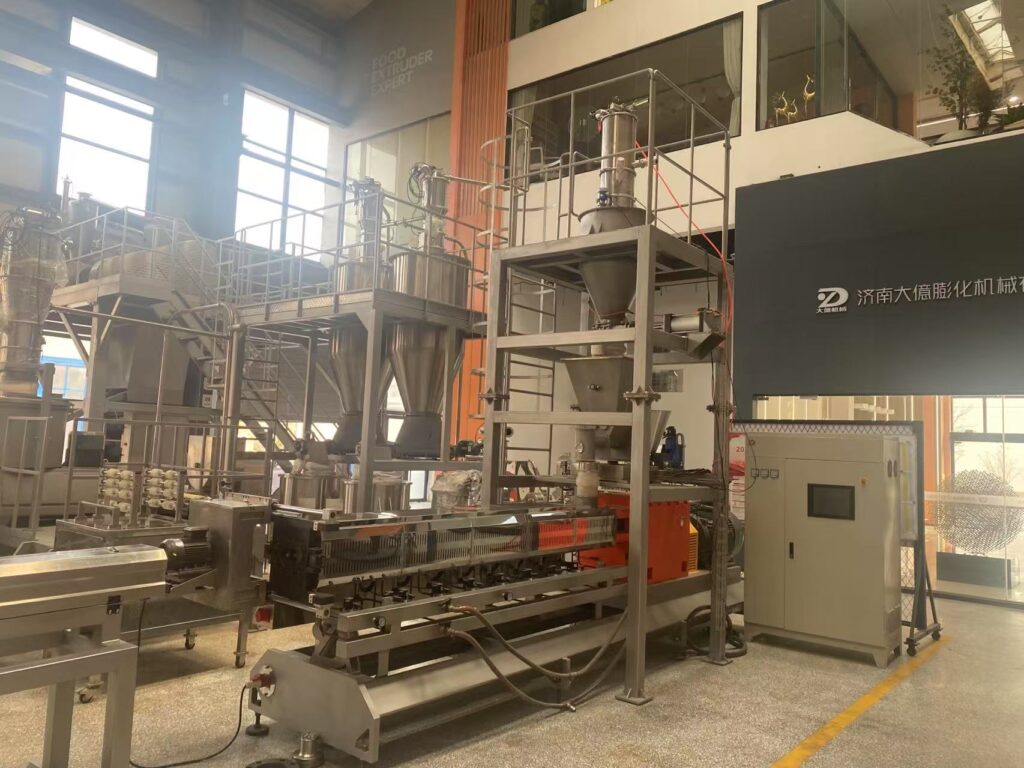
2. Feeding System (Raw Material Inlet Section)
The feeding system delivers ingredients into the extruder at a stable and controllable rate.
- Main feeder (dry feed hopper): Stores and meters powders or granules (e.g., flour, starch, protein). Loss-in-weight feeders are commonly used for accurate dosing.
- Liquid injection ports: Allow addition of water, oils, syrups, or other liquid ingredients to adjust moisture content and improve mixing.
- Pre-conditioner (optional): In many food and feed lines, a pre-conditioner partially hydrates and heats materials using steam/water before extrusion, reducing mechanical load and improving cooking efficiency.
A well-designed feeding section prevents bridging, improves flowability, and ensures consistent residence time and product uniformity.
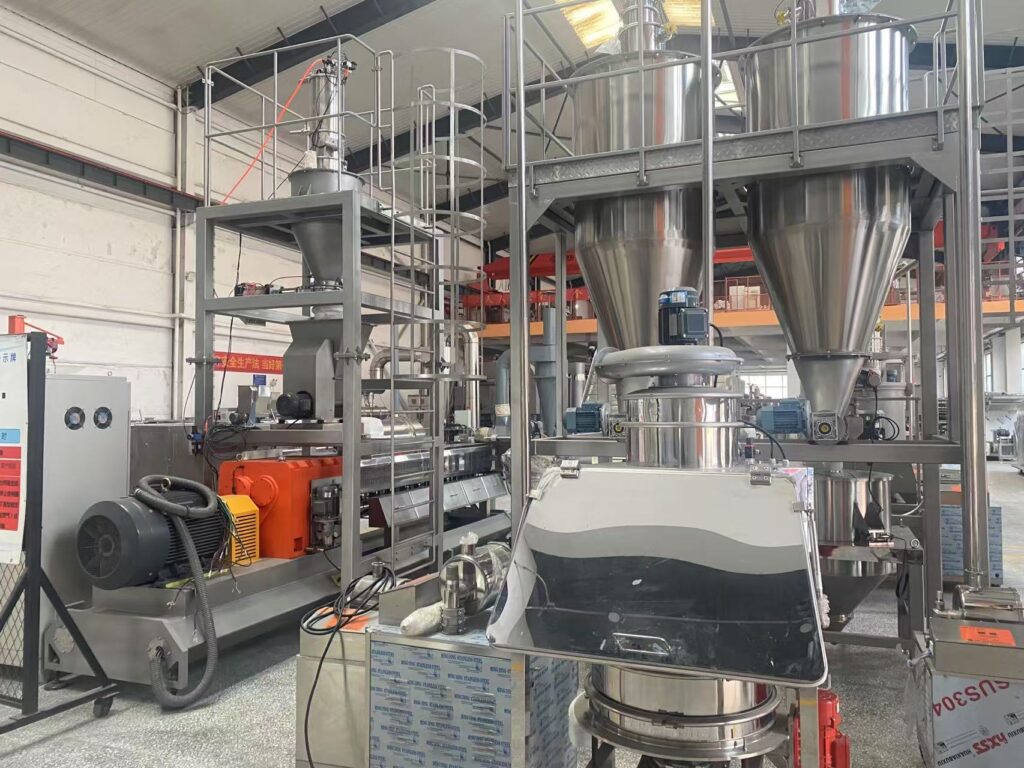
3. Screw Elements and Screw Shafts (Core Processing Unit)
The screws are the central working parts that determine conveying, mixing, shearing, and pressure development.
- Screw shafts: Two parallel shafts transmit torque from the gearbox to the screw elements.
- Modular screw elements: Twin-screw extruders typically use segmented screws assembled in specific sequences. Common element types include:
- Conveying elements: Move material forward and build moderate pressure.
- Kneading blocks (mixing elements): Provide intensive mixing and controlled shear; widely used for cooking, texturization, and dispersion.
- Reverse elements: Create backflow to increase residence time and mixing intensity.
- Special mixing elements: Designed to enhance distributive or dispersive mixing depending on product requirements.
Screw design (element type, length-to-diameter ratio, pitch, and configuration) strongly influences product expansion, density, texture, and energy consumption.
4. Barrel Assembly (Housing and Thermal Control)
The barrel encloses the screws and forms the processing channel where pressure, temperature, and shear are controlled.
- Barrel sections: Usually modular and bolted together for flexibility and maintenance.
- Liners (wear sleeves): Replaceable internal liners protect the barrel from abrasion, especially in high-fiber or mineral-rich formulations.
- Heating and cooling system: Electric heaters, steam jackets, and water cooling channels maintain target temperature profiles along the barrel. Precise temperature control is critical for starch gelatinization, protein denaturation, and melt viscosity stability.
- Process ports: The barrel contains openings for liquid injection, venting, sampling, and sensors.
5. Drive System: Motor, Gearbox, and Couplings
The drive system provides the mechanical energy required for extrusion.
- Main motor: Supplies rotational power; modern systems often use variable-frequency drives (VFD) for speed control.
- Gearbox (reduction and torque transmission): Converts motor speed into high torque suitable for processing viscous materials. Gearbox reliability is vital because extrusion involves high loads and continuous operation.
- Couplings and bearings: Transmit torque and support rotating shafts while minimizing vibration and misalignment.
Key performance indicators include torque capacity, speed range, efficiency, and thermal stability of the drive components.
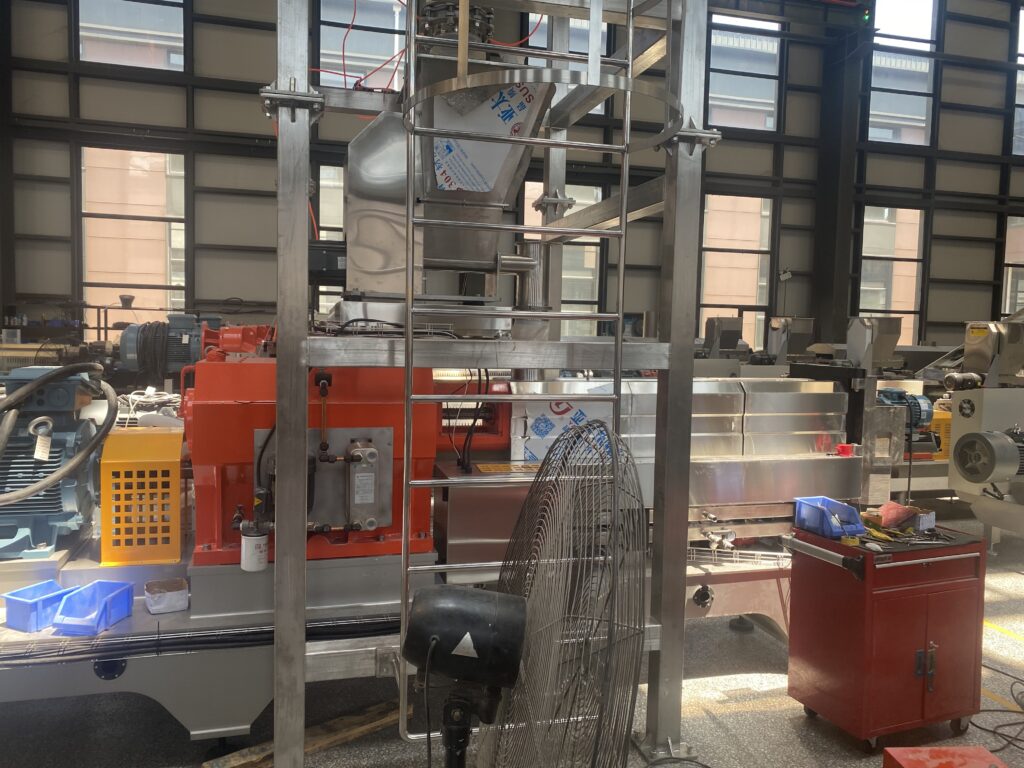
6. Feeding and Venting/Devolatilization Ports
Twin-screw extruders often include additional ports beyond the main inlet.
- Side feeder: Introduces heat-sensitive or low-bulk ingredients downstream to reduce over-processing (e.g., fibers, inclusions, or certain proteins).
- Venting ports (atmospheric or vacuum): Remove moisture, air, or volatile compounds. Vacuum venting is particularly useful for improving product density control, reducing bubbles, and stabilizing extrusion of high-moisture systems.
7. Instrumentation and Control System
Modern twin-screw extruders rely heavily on sensors and automation to ensure consistent product quality.
- Temperature sensors: Monitor barrel zone temperatures and sometimes product temperature.
- Pressure transducers: Measure melt pressure near the die to prevent overpressure and ensure stable flow.
- Torque and motor load monitoring: Indicate mechanical energy input and help detect blockages or formulation changes.
- Control panel/PLC: Coordinates screw speed, feeder rates, temperature zones, alarms, and data logging.
Effective control systems support process repeatability, traceability, and safer operation.
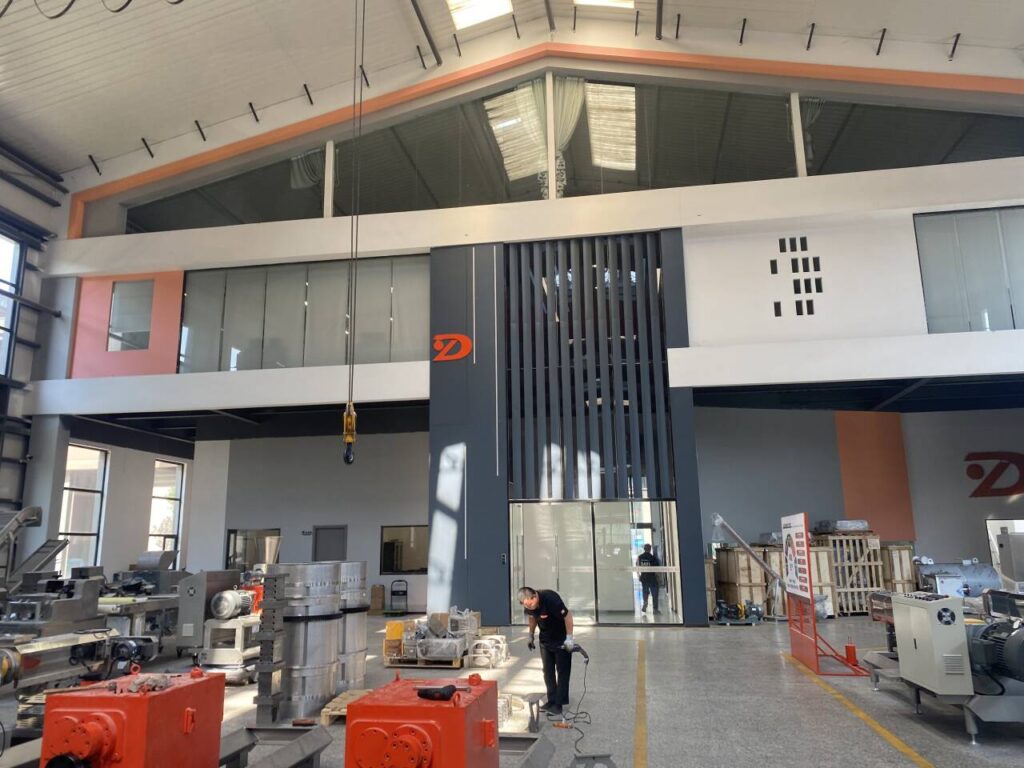
8. Die and Die Head (Shaping Section)
The die is the final shaping component that determines product geometry and influences expansion behavior.
- Die plate and inserts: Create specific shapes (rings, pellets, strands, sheets).
- Die heating: Prevents premature cooling and ensures smooth flow.
- Breaker plate/screen pack (in some designs): Helps homogenize flow and filter contaminants, though usage depends on product and wear considerations.
In expanded products, sudden pressure drop at the die exit causes water to flash into steam, driving expansion and porous structure formation.
9. Cutting and Downstream Equipment
Although not always considered part of the extruder body, downstream units are essential for final product formation.
- Rotary knife cutter: Cuts extrudate at the die face into pellets or pieces with controlled length.
- Conveying and drying systems: Cool and dry products to target moisture for shelf stability.
- Coating systems (optional): Apply oil, flavorings, or functional additives after extrusion.
10. Conclusion
A twin-screw extruder is an integrated system composed of feeding units, modular screws and shafts, a temperature-controlled barrel, a high-torque drive system, venting and side-feeding interfaces, instrumentation and controls, and a die/cutting assembly. Each component contributes to how materials are conveyed, mixed, cooked, and shaped. Proper component selection, screw configuration, and control strategy are fundamental to achieving stable operation and consistent product quality across different formulations and production targets.
 Spanish
  English
  Russian
  Italian
  Arabic
  Portuguese
  German
  French
  Japanese
  Moroccan Arabic
  Persian
  Belarusian