
Walk down the cereal aisle of any supermarket, and you’re met with a symphony of bright colors, cartoon mascots, and promises of “whole grains” and “essential vitamins.” The box of corn flakes in your cart seems simple enough: toasted flakes of corn, ready to be doused in milk. It feels wholesome, almost rustic.
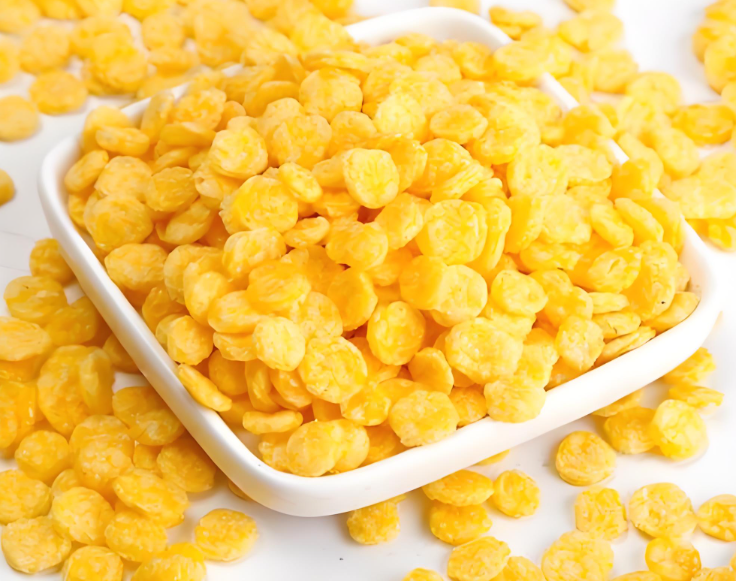
But to understand what you’re actually eating, you have to leave the kitchen behind and step into the industrial mega-facility where this “simple” breakfast is actually constructed. The journey of the corn flake is not one of artisanal baking, but one of high-pressure engineering, chemical processing, and nutritional alchemy.
Step 1: The Refining
It starts with corn. But not the sweet corn you buy at a farmer’s market. The industry uses No. 2 Yellow Dent Corn, a commodity crop grown primarily for animal feed, ethanol, and industrial starch. The first stop is the “wet milling” process. The kernels are steeped in vats of hot water and sulfur dioxide—a toxic preservative—for 24 to 40 hours. This separates the kernel into its components: germ, fiber, protein, and starch.
For corn flakes, the goal is to strip the kernel down to its bare bones: refined corn starch. The germ (which contains the nutritious oils that would go rancid quickly) and the bran (which contains fiber) are removed and sold off—usually to make animal feed or corn syrup. What remains is a slurry of purified starch and water called “grits.” The very thing that made the corn a whole grain has been systematically removed to ensure shelf stability and a uniform texture.
Step 2: The Cooker
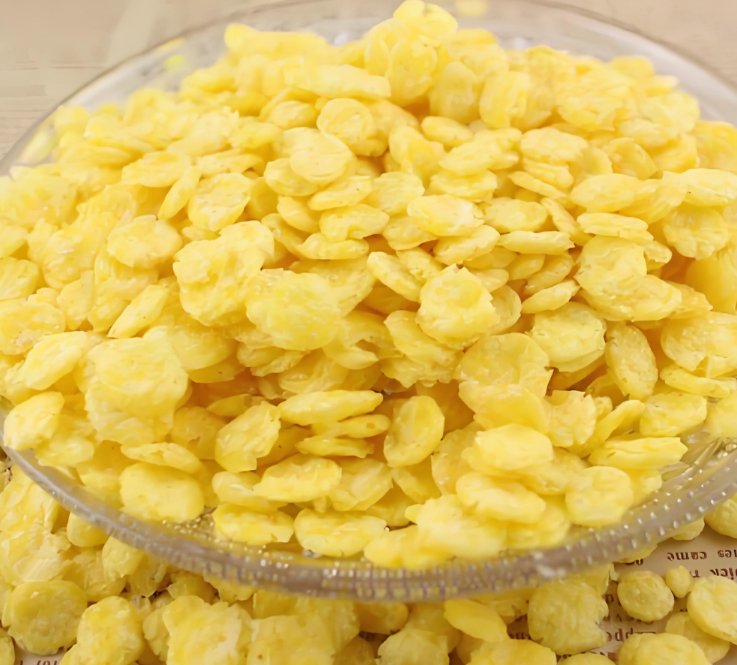
If you tried to make a flake out of raw corn flour, it would crumble. To create the rigid, glass-like structure of a cereal flake, the starch must be cooked under extreme conditions. The corn grits are loaded into industrial pressure cookers known as cooker-extruders.
Inside these massive machines, the mixture is blasted with steam and subjected to pressures of up to 200 psi. Sugar, malt flavoring, and a hefty dose of salt are added. But the key ingredient is a proprietary blend of maltodextrin and sugar syrups, which acts not just as a sweetener but as a structural binder.
Crucially, this high-heat, high-pressure process destroys the majority of the fragile vitamins that naturally occur in corn. Whatever nutrients were left after the refining process are now denatured by the steam injection.
Step 3: The Tempering and Sheeting
Once the dough-like “cook” exits the pressure cooker, it enters a tempering phase. The massive, hot lumps of dough are left to rest for hours to evenly distribute moisture. Then, they pass through a series of heavy steel rollers—some weighing several tons—that flatten the dough into a thin ribbon.
But this isn’t like rolling out pie crust. The rollers are calibrated to align the starch molecules under extreme mechanical shear. This alignment is what will later create the characteristic “snap” of the flake.
Step 4: The Flaking and The Kiln
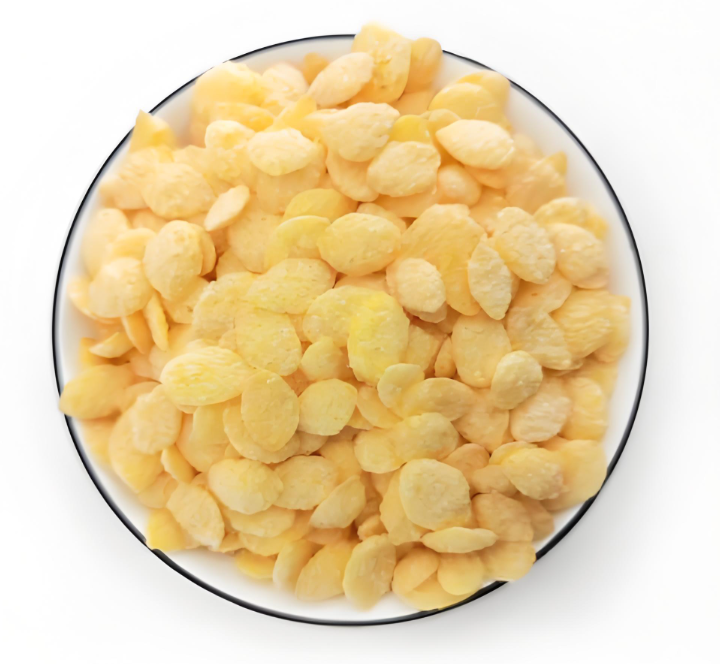
This is where the illusion begins. The ribbon of dough is cut into individual flake-sized pellets. These are not yet flakes; they are dense, moist pellets. They are dropped from a great height into high-velocity pneumatic guns that shoot them into the kiln (the oven).
As the pellets hit the rotating drum of the kiln, they are flattened by steel rollers and blasted with temperatures exceeding 550°F (288°C). This rapid expansion of steam inside the pellet causes it to puff and curl into the familiar flake shape. But the heat does more than just shape the flake; it initiates the Maillard reaction—the browning effect that gives the cereal its toasted, nutty flavor.
However, because the corn has been stripped of its natural oils and proteins, this browning is weak. To compensate, many manufacturers spray the flakes with a fine mist of artificial browning agents or barley malt syrup to achieve that consistent golden hue.
Step 5: The Chemical Fortification
Remember how the original nutrients were destroyed in the refining and cooking process? Now comes the “fortification.”
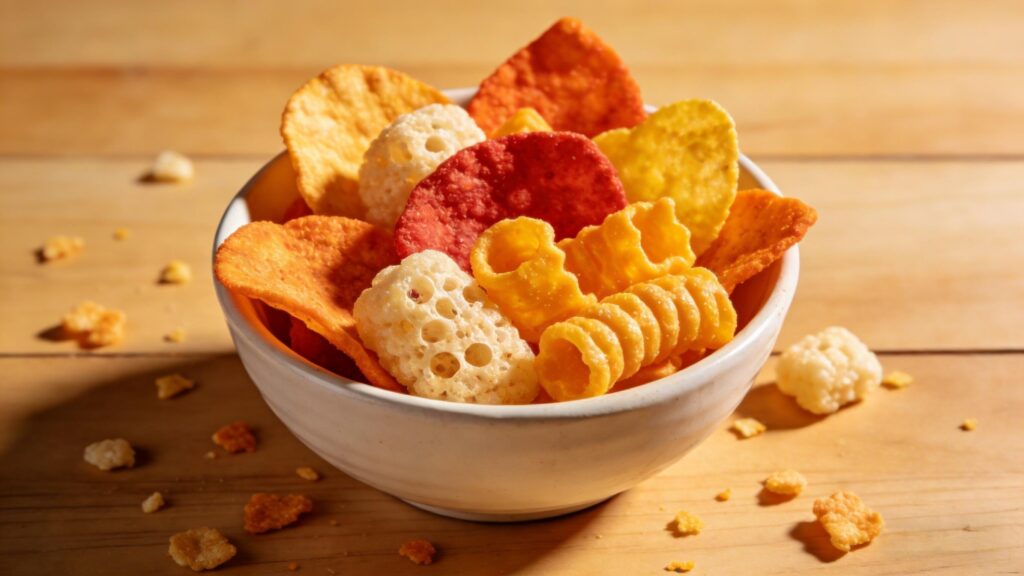
As the flakes tumble out of the kiln, they are sprayed with a “vitamin premix.” This is a liquid cocktail typically consisting of synthetic vitamins: ferric orthophosphate (iron), pyridoxine hydrochloride (B6), riboflavin (B2), and folic acid. While these vitamins are essential, they are synthetic isolates, not the complex nutrient matrices originally present in the whole grain.
The spray also contains BHT (Butylated Hydroxytoluene) , a petroleum-derived preservative that keeps the fats in the cereal from spoiling. Despite the fact that the manufacturer removed the natural oils to begin with, BHT is added to ensure the cereal can sit on a shelf for a year or more without going stale.
Step 6: The Sugar Coating (The “Flavor” System)
Finally, the flakes pass under a curtain of liquid sugar or, in the case of “original” corn flakes, a fine mist of sugar solution. Contrary to the wholesome image, there is no such thing as unsweetened commercial corn flake; the sugar is essential to the structural integrity of the flake and to mask the metallic aftertaste of the synthetic vitamins.
To ensure the flakes look dry and “natural,” the sugar coating is flash-dried with high-velocity air, leaving a matte finish that hides the crystalline sugar layer underneath.
The Finished Product
What emerges is a marvel of industrial chemistry: a flake that is structurally rigid, shelf-stable for years, and bio-engineered to stay crunchy in milk for exactly 12 to 15 minutes (a texture known in the industry as “crispness retention”).
Nutritionally, however, it is a ghost of its original source. A bowl of corn flakes starts as a whole grain, but after milling, pressure cooking, sheeting, kilning, and fortification, it becomes a product composed primarily of rapidly digestible starch and sugar. It enters the bloodstream quickly, spiking blood sugar levels before the morning is over—a phenomenon that metabolic scientists argue contributes to the mid-morning energy crash.
The golden flake isn’t baked; it’s manufactured. It isn’t whole grain; it’s refined starch held together by sugar. And while the box boasts about the vitamins that were added back in, it doesn’t mention the complex fiber, oils, and proteins that were taken out.
It’s a classic industrial trade-off: shelf life and convenience, engineered at the cost of nutritional integrity.
If you are interested in the breakfast cereal making machine , you can contact me , i will give you good advice and solutions .
1.Will you help us with the installation ?
Yes , We will send engineers to install and debug the equipment, and assist in training your staff.
2.Are you a factory or trading company?
We are a factory.
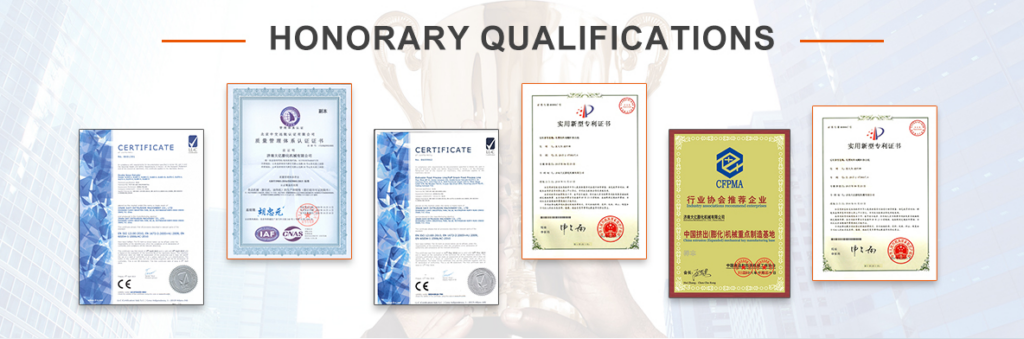
3.What certificate do you have?
We have ISO and CE certificate.
4.How long is the warranty period?
All of our machines have one year warranty.
5.What’s the main market of your company?
Our customers all over the world.
6.How much production capacity of your company one year?
This depends on your needs.
 German
  English
  Russian
  Spanish
  Italian
  Arabic
  Portuguese
  French
  Japanese
  Moroccan Arabic
  Persian
  Belarusian