
Puffed Breadcrumb Processing Technology: Engineering Air & Crunch
Puffed breadcrumbs represent a specialized and technologically advanced category within the coating industry. Distinguished by their exceptionally light, airy, and crispy texture—often even crispier than traditional dry breadcrumbs or Panko—they are engineered through a process that combines baking and extrusion puffing. This article outlines the key stages in the industrial manufacturing of puffed breadcrumbs.
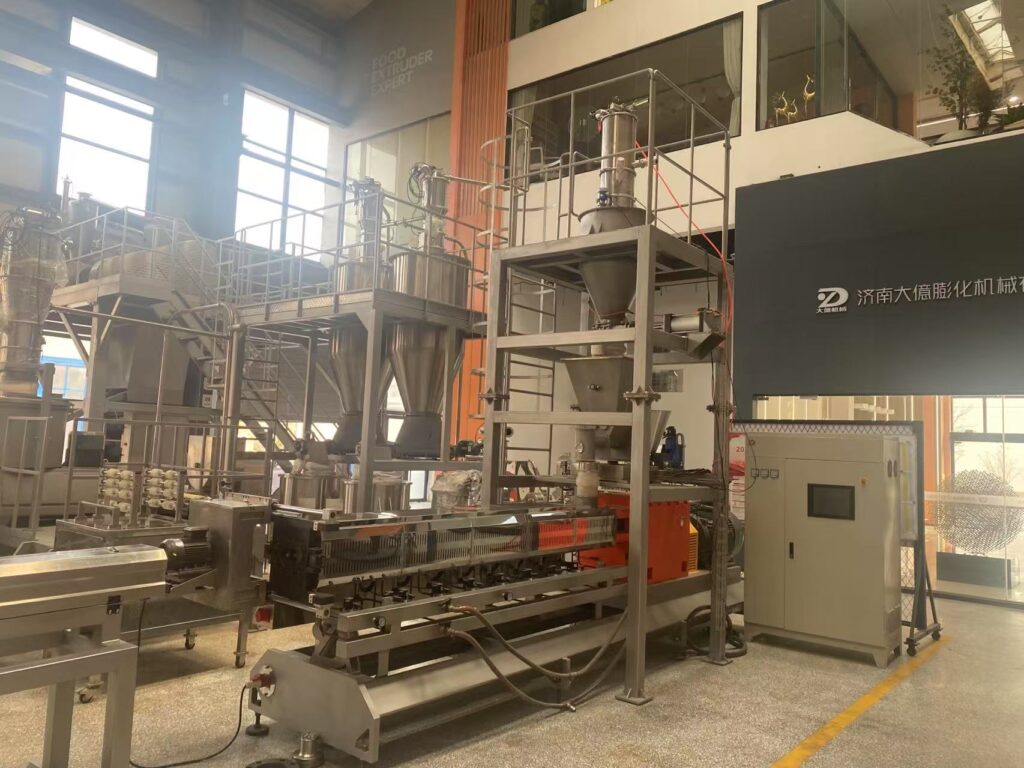
1. Raw Material Selection & Preliminary Processing
- Base Ingredient: The primary raw material is typically starch-rich bread flour (wheat or a blend), not dried bread. This allows for precise control over the final product’s composition and functionality. Some blends may include corn starch, rice flour, or other grains to modify texture and expansion.
- Mixing: The dry ingredients are combined with water, and minor additives in a high-speed mixer to form a uniform, damp dough. Key additives may include:
- Leavening Agents: (e.g., baking powder) to initiate gas formation.
- Yeast: For biological fermentation and flavor development in some products.
- Salt, Sugar, & Seasonings: For baseline flavor.
- Emulsifiers & Stabilizers: To improve dough consistency and final texture.
2. Dough Fermentation (Optional but Common)
The dough may be allowed to rest or undergo a short fermentation period. This step develops flavor, allows hydration to fully penetrate the flour particles, and lets the leavening agents begin producing gas bubbles—the nuclei for future puffing.
3. Baking into a Primary “Bread” or Sheet
The dough is not immediately extruded. Instead, it is baked in a continuous oven to form a low-moisture, partially cooked “crumb” base or a thin sheet. This critical step:
- Sets the protein (gluten) network.
- Gelatinizes the starch.
- Reduces the moisture content to a specific, controlled level (typically lower than fresh bread but higher than fully dried product).
- Creates the initial, dense structure that will be dramatically transformed in the next step.
4. Size Reduction & Conditioning
The baked intermediate product is coarsely ground or crushed into small granules, pellets, or “pre-crumbs.” These pieces are then often conditioned—allowed to sit in a controlled environment—to ensure moisture is evenly distributed throughout each particle. Uniform moisture is critical for consistent puffing.
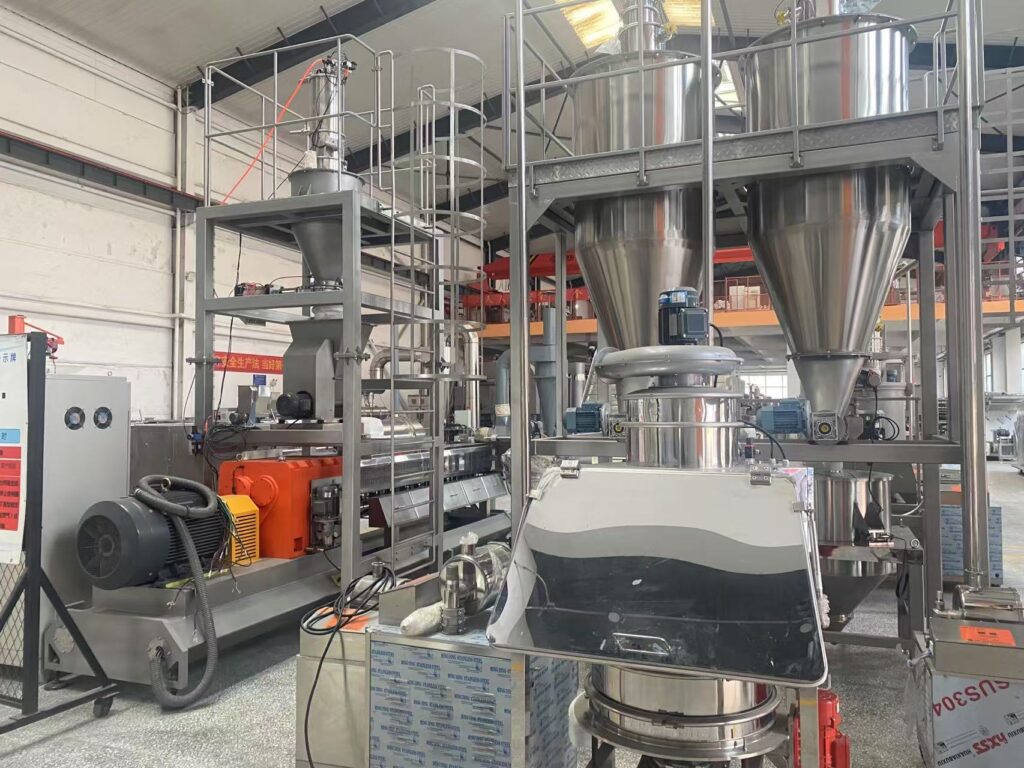
5. The Core Technology: Extrusion Puffing
This is the defining stage that creates the signature airy structure. The conditioned crumbs are fed into a twin-screw extruder.
- The extruder subjects the material to high temperature, high pressure, and intense mechanical shear.
- The residual moisture inside each crumb particle turns into superheated steam.
- As the material is forcefully expelled through a die at the end of the extruder barrel, it experiences a sudden pressure drop to atmospheric pressure.
- This instantaneous pressure release causes the superheated steam to expand violently, “exploding” or puffing each crumb particle from the inside out. The starch matrix stretches, creating a porous, honeycombed, or multi-cellular airy structure.
- The product is simultaneously fully cooked and dried by this process.
6. Drying & Toasting (Post-Puffing)
The puffed extrudate may still contain some residual moisture. It passes through a final drying or toasting oven (often a multi-zone belt dryer) to achieve a very low, stable final moisture content (e.g., 3-8%). This ensures crispness and shelf stability. This stage also develops the final golden color and roasted, toasted flavor notes.
7. Milling & Sizing
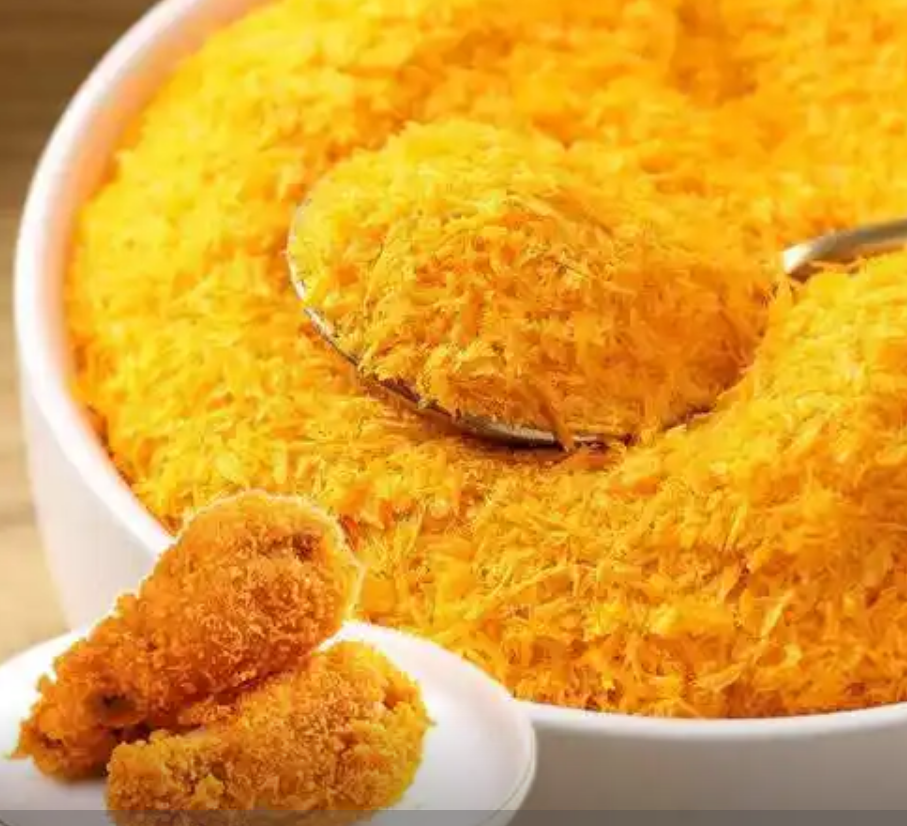
The dried, puffed pieces (which can look like irregular, airy pellets) are now milled or ground to the desired final particle size. This is done using specialized crushers and screens to produce anything from fine powder to coarse flakes, similar in size to traditional breadcrumbs or Panko but with a completely different internal architecture.
8. Cooling, Screening, & Packaging
- The crumbs are cooled to ambient temperature to prevent condensation in the package.
- They pass over vibrating screens to remove fines and ensure uniform particle size distribution.
- Finally, they are packaged in moisture-proof bags or containers, often under modified atmosphere (e.g., nitrogen flushing) to maximize shelf life and retain crispness.
Key Characteristics of the Final Puffed Breadcrumb:
- Ultra-Light Density: Due to the high air content.
- Superior Crispiness & Crunch: The brittle, glassy, porous structure shatters easily.
- High Expansion Ratio: Significant volume increase from the pre-puffed pellet.
- Low Oil Absorption: The sealed, puffed cells tend to absorb less oil during frying compared to more porous traditional crumbs, resulting in a lighter, less greasy coating.
- Excellent Adhesion: The irregular, textured surface provides a good key for batters and egg washes.
Conclusion
The processing of puffed breadcrumbs is a sophisticated application of food extrusion technology. It transforms a simple dough into a highly functional, engineered food ingredient by manipulating heat, pressure, and moisture. The result is not merely a dried piece of bread but a purpose-built, aerated structure designed to deliver maximum crunch, minimal density, and superior coating performance for the food industry, particularly in premium frozen fried foods and snacks.
 German
  English
  Russian
  Spanish
  Italian
  Arabic
  Portuguese
  French
  Japanese
  Moroccan Arabic
  Persian
  Belarusian