In the heart of countless industrial plants—from pet food factories to cereal mills and plant-based protein labs—hums a machine of remarkable versatility and precision: the twin-screw extruder. Far more than a simple cooker, it is a sophisticated, continuous chemical and mechanical reactor that extruder machine transforms raw powders and pastes into a vast array of finished products. This is the workhorse behind the shape, texture, and nutrition of modern processed foods.
Core Principle and Design
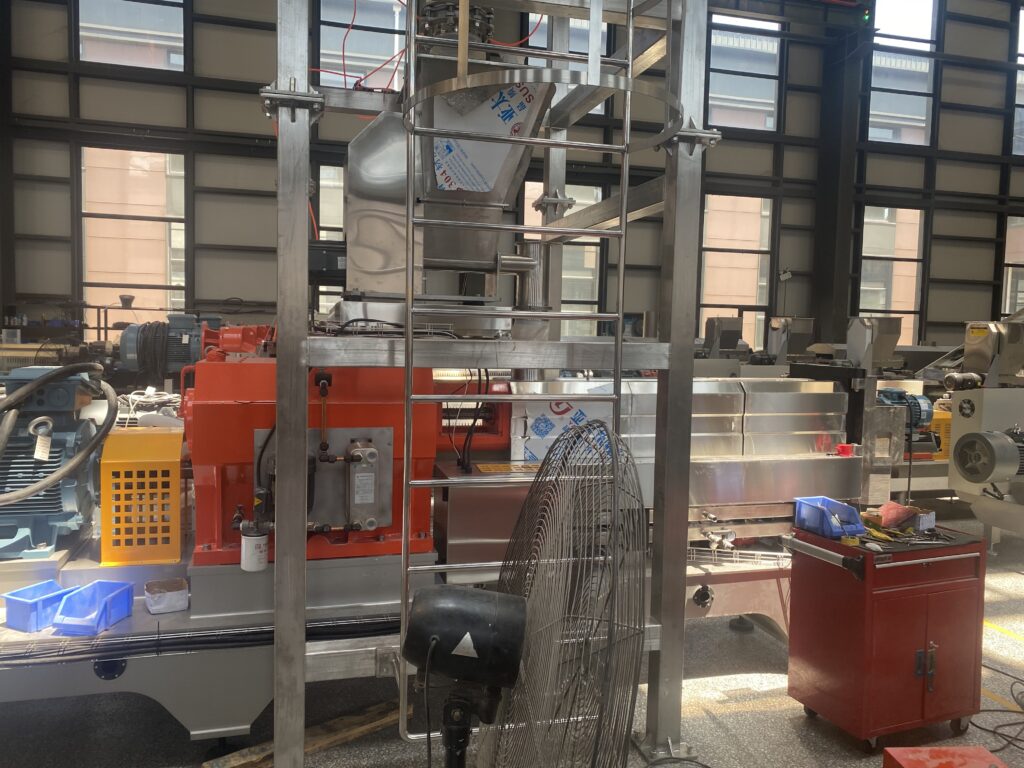
At its essence, a twin-screw extruder is a barrel housing two intermeshing, co-rotating or counter-rotating screws mounted on parallel shafts.extruder machine This twin-screw design is its key advantage over older single-screw machines, offering superior control, mixing efficiency, and flexibility.
Raw ingredients (flours, meals, starches, proteins) are fed into the barrel via a hopper. As the screws rotate, they:
- Convey the material forward.
- Mix, shear, and knead it into a uniform dough.
- Cook it through a combination of friction-induced heat (from the intense mechanical shear between screws and barrel) and external heating from barrel jackets.
- Pressurize the molten mass before forcing it through a specialized shaping die at the end of the barrel, known as the die head.
Upon exiting the high-pressure environment of the die, the product expands or “puffs” rapidly—a process called expansion—as superheated water instantly vaporizes. This final step is what creates the airy texture of breakfast cereals, the crunchy bite of kibble, or the fibrous structure of textured vegetable protein (TVP).
Key Advantages: Why Twin-Screws Dominate
The intermeshing, self-wiping action of the twin screws provides unparalleled benefits:
- Exceptional Mixing and Uniformity: The screws create intense laminar and distributive mixing, ensuring even incorporation of fats, colors, flavors, and micronutrients throughout the dough. This guarantees product consistency bite after bite.
- Precise Process Control: Operators can independently control variables like screw speed, barrel temperature in different zones, feed rate, and moisture addition. This allows for “tuning” the machine to create everything from dense, semi-moist products to light, highly-expanded snacks.
- High Flexibility and Versatility: By changing the screw configuration (using different screw elements like forwarding kneaders, reverse elements, or sealing rings), barrel length, and die shape, the same machine can produce a wide range of products. It can handle high-moisture doughs, sticky materials, and formulations with high fat or fiber content—challenges for single-screw extruders.
- Efficient Cooking (Thermomechanical Processing): The machine efficiently uses mechanical energy (shear) and thermal energy to gelatinize starches, denature proteins, and deactivate enzymes or anti-nutritional factors (e.g., in soy), extruder machine all in a matter of 1-2 minutes. This short-time, high-temperature process helps preserve some heat-sensitive nutrients compared to prolonged baking.
Industrial Applications: Shaping What We Eat
The twin-screw extruder is foundational to multiple industries:
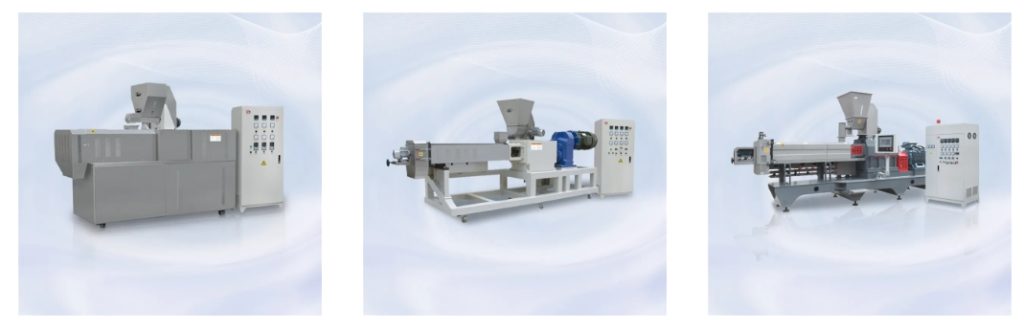
- Pet Food & Aquafeed: It is the standard for producing dry, expanded kibble. It efficiently binds cereals and animal meals, cooks the starch for digestibility, and creates a stable, shelf-safe structure that can be coated with fats and palatants.
- Breakfast Cereals & Snacks: It creates the shapes—from loops to flakes to puffs—and the crisp, soluble texture of ready-to-eat cereals and direct-expanded snacks (cheese puffs, etc.).
- Textured Vegetable Protein (TVP): By extruding defatted soy or other plant protein flours, it creates the chewy, fibrous, meat-like structure used in vegetarian products and meat extenders.
- Precision Nutrition & Ingredients: It’s used to produce modified starches, instant porridges, baby food, and encapsulated ingredients (e.g., protecting vitamins or probiotics within a starch matrix).
- Biodegradable Materials: Beyond food, the technology is used to process bioplastics and starchy packaging materials.
The Engineering Behind the Scenes
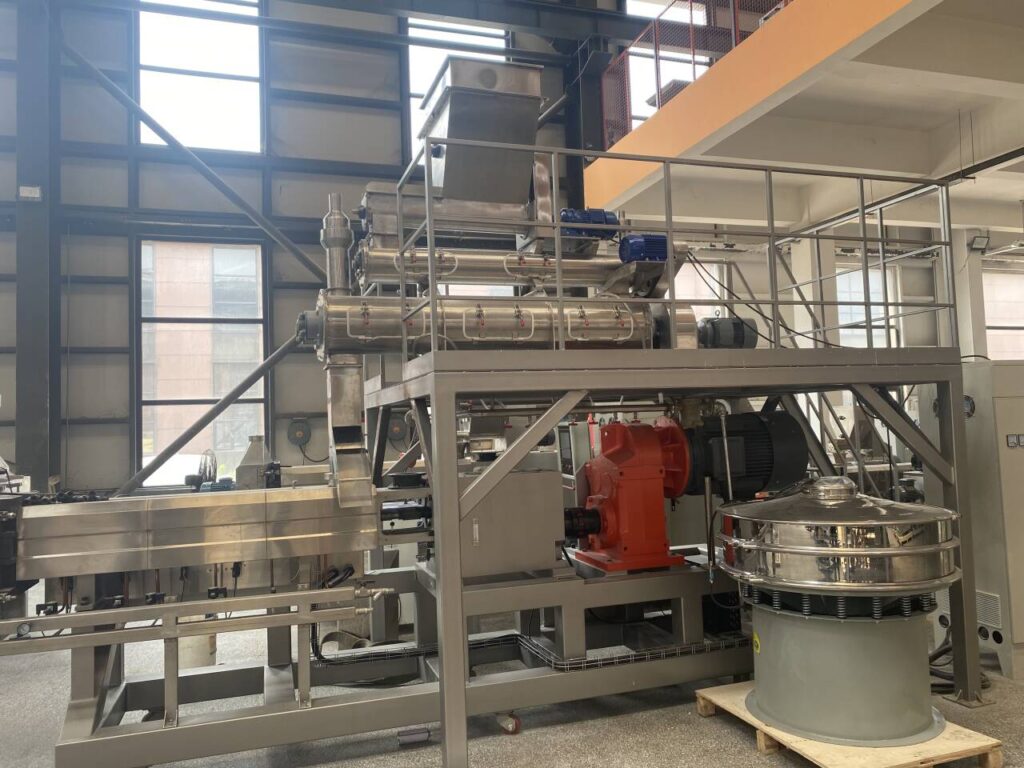
A complete extrusion line is more than the extruder itself. extruder machine It is a synchronized system including:
- Pre-conditioner: A mixing chamber where ingredients are pre-heated and moistened with steam and water for more uniform cooking.
- The Extruder Barrel: Divided into multiple temperature-controlled zones for sequential functions: feeding, mixing, cooking, and melting.
- The Die & Cutting Assembly: The shaped die gives the product its final form. A high-speed rotary knife at the die face cuts the emerging strands into precise lengths.
- Downstream Dryers, Coolers, & Coaters: Post-extrusion, products are dried to a safe moisture level, cooled, and often coated with oils, flavors, or vitamins.
Conclusion: A Pillar of Modern Manufacturing
The twin-screw extruder is a quintessential example of food engineering. It is a machine of immense transformative power, turning raw, often unappealing ingredients into safe, palatable, and functional foods at remarkable speed and scale. While often associated with ultra-processing, its precise control also enables the creation of nutritious, tailored foods for specific dietary needs. As the demand for plant-based proteins and functional ingredients grows, the twin-screw extruder remains at the forefront, continuously engineered to shape the future of our food supply—one precise, puffed piece at a time.
 Moroccan Arabic
  English
  Russian
  Spanish
  Italian
  Arabic
  Portuguese
  German
  French
  Japanese
  Persian
  Belarusian