The drive system is the powerhouse of an extruder, responsible for converting electrical energy into the controlled, high-torque mechanical rotation of the screw(s). food extruder machine It is a critical subsystem whose performance directly determines the machine’s processing capability, stability, product quality, and energy efficiency. Far more than just a motor, the modern extruder drive is an integrated assembly of several key components working in concert.
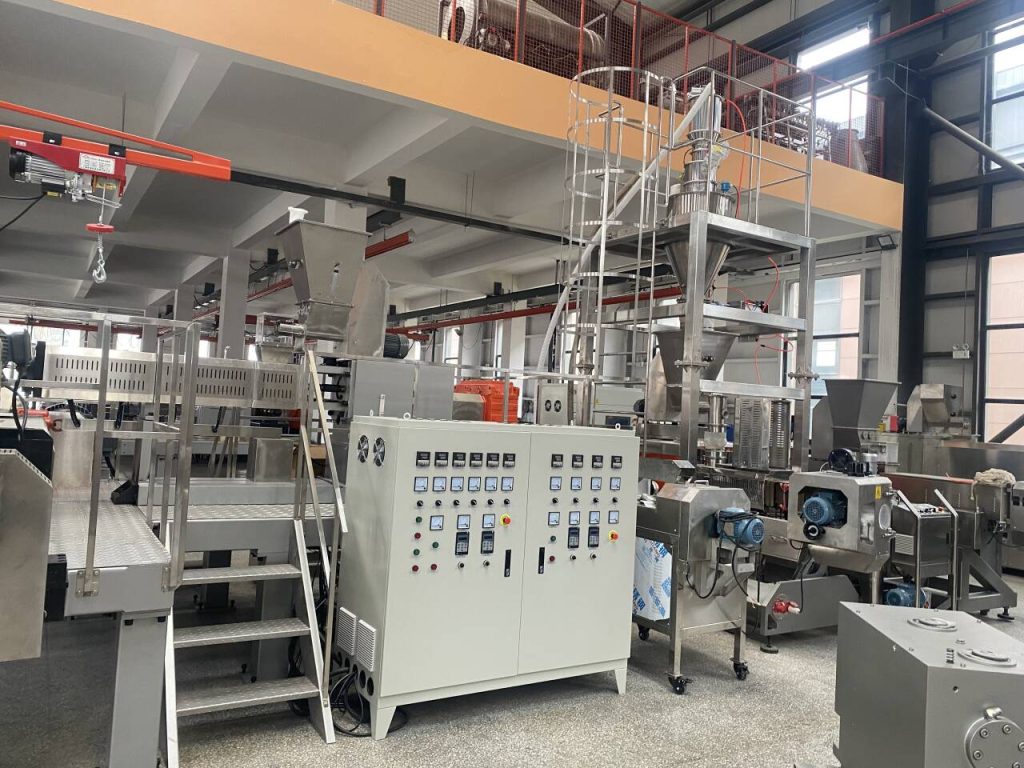
Core Components of the Drive System:
1. Prime Mover (Motor):
This is the primary source of power. For industrial extruders, two main types are prevalent:
- AC Variable Frequency Drive (VFD) Motors: The most common choice in modern systems. food extruder machine A standard AC induction motor is paired with a sophisticated Variable Frequency Drive (VFD). The VFD controls the motor speed by varying the frequency and voltage of the electrical supply, allowing for smooth, wide-range speed adjustment. These systems are robust, energy-efficient, and offer excellent control.
- DC Motors: Traditionally used for their inherent variable speed capability through armature voltage control. While they offer high starting torque and good speed control, they often require more maintenance (brush replacement) and are generally less efficient than modern AC VFD systems, making them less common in new installations.
2. Gear Reducer (Transmission):
The motor typically rotates at high speeds (e.g., 1,200-1,800 RPM), while the extruder screw requires much lower speeds (often 100-500 RPM for twin-screw, higher for some single-screw) but with massively increased torque. The gear reducer, a high-precision,food extruder machine heavy-duty gearbox, performs this critical function. It reduces the motor’s output speed while proportionally increasing the torque delivered to the screw shaft. Its design must handle extreme and fluctuating loads without excessive backlash or energy loss.
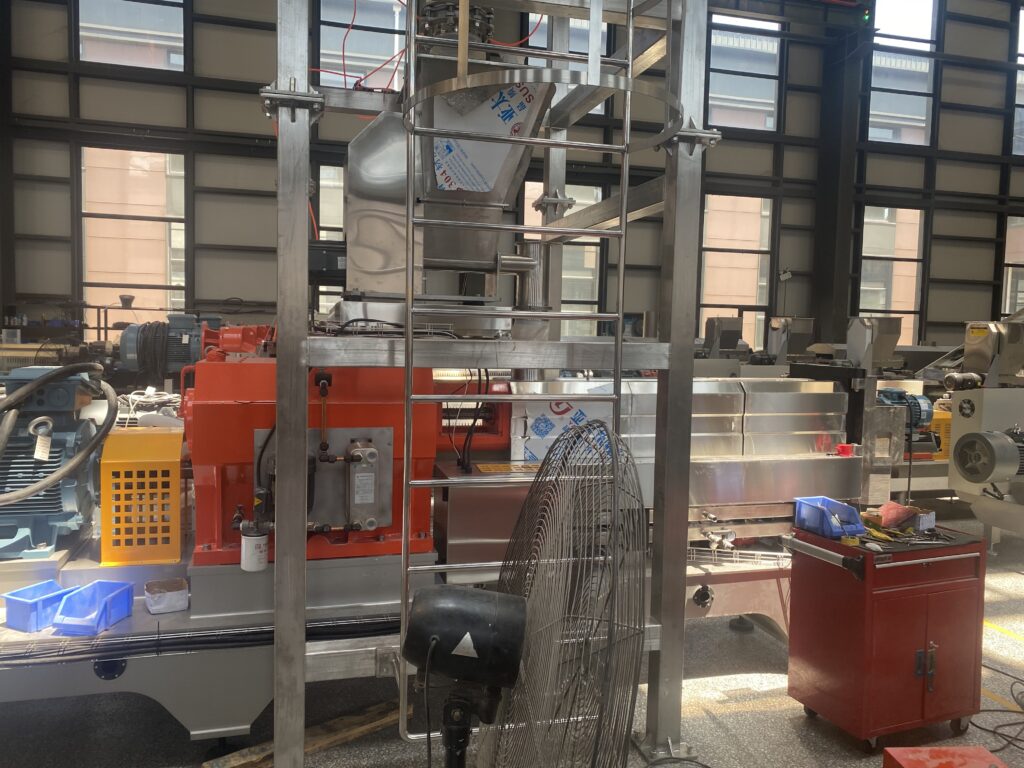
3. Coupling / Torque Limiter:
This component connects the output shaft of the gear reducer to the input shaft of the extruder screw. Its functions are vital:
- Misalignment Accommodation: Compensates for minor misalignments between the gearbox and screw shaft.
- Shock Absorption: Dampens torque fluctuations and vibration.
- Overload Protection: Often incorporates a shear pin or mechanical/electronic torque limiter that disengages or triggers an alarm if torque exceeds a safe threshold (e.g., during a sudden jam), protecting the gearbox, motor, and screw shafts from catastrophic damage.
4. Thrust Bearing Assembly:
This is arguably one of the most heavily stressed parts of the drive train. food extruder machine As the screw conveys material forward, it encounters significant resistance, generating immense axial (back-thrust) force pushing the screw assembly backward toward the motor. A massive, specially designed thrust bearing assembly, located either within the gearbox housing or between the coupling and the screw shaft, absorbs this entire axial load, preventing it from damaging the gear reducer and motor. Its reliability is paramount for continuous operation.
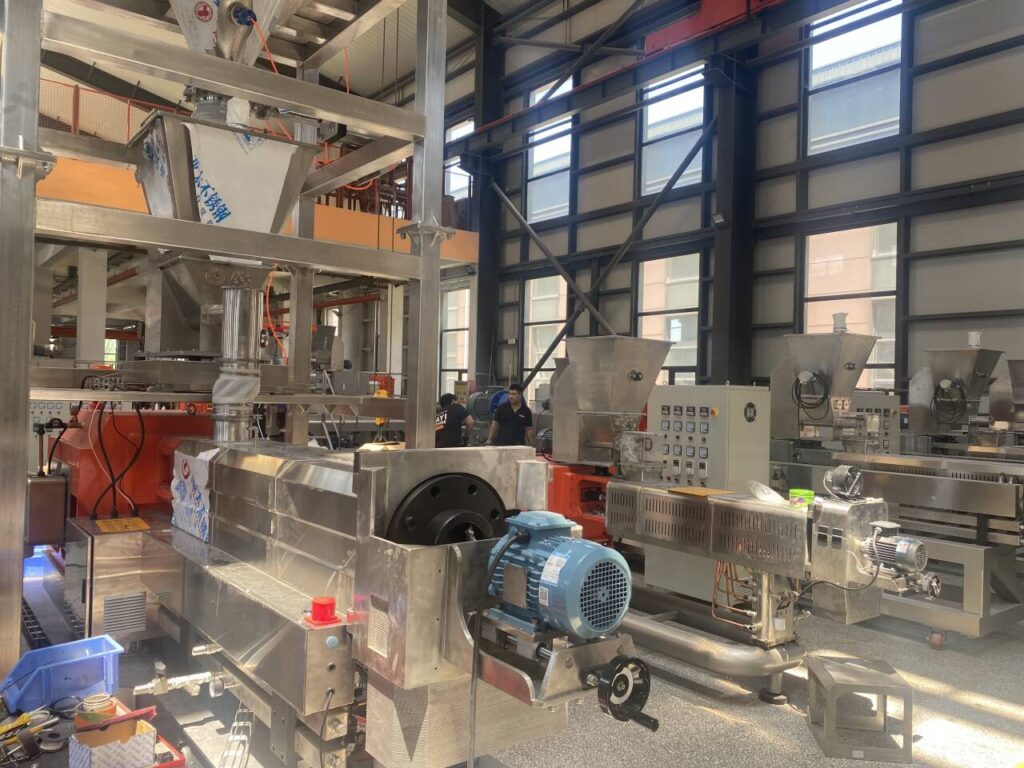
5. Control and Sensing Integration:
The drive is not mechanical alone; it is fully integrated into the machine’s electronic control system.
- Speed Control: The operator sets the desired screw speed (RPM) via the Human-Machine Interface (HMI). The control system (PLC) regulates the motor (via VFD) to maintain this speed precisely, even as processing conditions change.
- Torque Monitoring: A current transducer or dedicated torque sensor measures the motor’s load, which is directly proportional to screw torque. This is displayed as % motor load or amperage on the HMI.
- Critical Feedback: Torque and speed are the two most vital real-time process indicators. A rising torque at constant speed signals increased viscosity (e.g., higher moisture, cooking degree). The system uses this data for process monitoring, alarming, and sometimes for automated control loops (e.g., adjusting feeder rates based on torque).
Key Performance Requirements:
- High Torque at Low Speed: The system must deliver immense rotational force even at low screw speeds, especially when starting under load.
- Variable Speed with Precision: Smooth, responsive, and precise speed control is essential for product consistency and recipe changes.
- Constant Torque Capability: The drive must maintain torque output across the operating speed range.
- Durability & Overload Protection: It must withstand 24/7 operation under harsh conditions and include robust safety mechanisms.
- Energy Efficiency: Modern drives focus on converting electrical power to mechanical work with minimal losses.
The extruder drive system is a masterclass in controlled power transmission. food extruder machine It transforms raw electrical input into the precise, forceful, and measurable rotation that drives the entire extrusion process. By managing speed and torque—and providing critical data through load monitoring—it forms the operational backbone, allowing processors to achieve the specific mechanical shear and energy input required to transform raw ingredients into countless expanded and textured products. Its reliability and sophistication are fundamental to modern extrusion technology.
 English
  Russian
  Spanish
  Italian
  Arabic
  Portuguese
  German
  French
  Japanese
  Moroccan Arabic
  Persian
  Belarusian